A Matter of Scale: What Nuclear Can Learn from Oil & Gas Waste Management


Executive Summary
As global demand for energy continues to rise, the forms of energy we choose to pursue are increasingly falling under scrutiny in America and western countries. For every type of energy production, there are associated wastes e.g. ash from coal, turbine blades from windmills, and air pollution from any combustion process. As a society, we must strike a balance between creating the lifesaving, inexpensive, reliable energy we require for modernity while minimizing our waste and its associated environmental impact. Frequently, the most misunderstood and often feared waste in energy production is spent nuclear fuel (SNF). While there are special precautions linked to SNF, the volume of toxic waste associated with nuclear energy pales in comparison to that of the dominant US and global energy source: oil and gas.
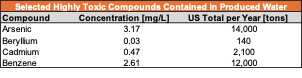
By only considering the hazardous material within “produced water,” a byproduct of oil and gas production that contains water, hydrocarbons, salts, heavy metals, and sometimes radioactive material, the US oil and gas industry generates ~28 billion barrels of produced water every year, which contains ~580 million tons of total dissolved solids. Much of that solid waste is composed of salts, but it also contains several highly toxic compounds including up to 14,000 tons of Arsenic and over 12,000 tons of Benzene, both known carcinogens. By comparison, the US nuclear industry, which produces just under one fifth of the country’s electricity, only generates approximately 2,000 tons of spent nuclear fuel annually. Of those 2,000 tons, 95% can technically be recycled, leaving only 100 tons of nuclear waste produced each year.
While both sectors produce waste, the oil and gas industry disposes of massive quantities of toxic material with minimal public resistance. Nuclear, despite generating only a fraction of that waste, safely and in tightly regulated systems, faces intense scrutiny and overregulation. If oil and gas proves large-scale waste can be managed safely and cost effectively, why is nuclear still treated like an exception? It’s time to challenge the double standard and rethink the narrative.
Oil and Gas Waste: Produced Water and How it’s Managed
Oil and gas drilling generates a variety of waste materials, each with associated environmental challenges. These wastes include drilling fluids, drilling cuttings, sludge, produced water, and chemical additives. As the largest waste stream in the industry, produced water is a great benchmark for comparing waste between the oil and gas and nuclear industries.
Produced water originates from either fluid used in hydraulic fracturing or associated water native to the producing formation that is brought to the surface during the production of oil and natural gas. While its composition can vary significantly depending on geology and production methods, produced water is typically high in total dissolved solids (TDS), hydrocarbons, heavy metals, chemical additives, and in some cases, naturally occurring radioactive materials (NORM). In many cases NORM levels far exceed drinking water standards and can consist of radioactive isotopes such as uranium, radium, and thorium, all of which are naturally occurring, but can become highly concentrated in produced water. Aside from radioactive material, produced water contains several non-radioactive, highly toxic compounds including arsenic, beryllium, cadmium, and benzene, which remain toxic indefinitely. In contrast, the radioactivity of spent nuclear fuel decays over time, even though the material itself remains toxic if ingested. The hazardous nature of produced water constituents typically makes it unsuitable for direct discharge into the environment without treatment. Based on data collected from 46 produced water samples at unconventional operations in the Permian Basin and ten surface water samples from the Pecos River in New Mexico, the table below shows the concentration and extrapolated annual production of four highly toxic compounds found in produced water (Jiang et al.,2022).[1]
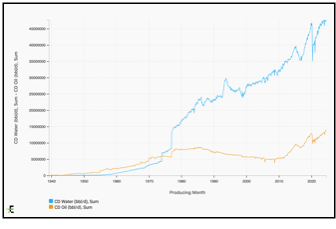
Since the volume of produced water is several times greater than the volume of oil extracted, the sheer quantity of produced water generated every day is immense, with roughly 28 billion barrels being generated in the US last year. This is the same volume of water that flows through the Mississippi River in New Orleans every three days. Cumulative produced water and oil production are plotted below. Note how produced water production far outweighs the production of oil. All this waste must be managed, and to meet the need, the oil and gas industry has developed extensive infrastructure to collect, recycle, and dispose of large quantities of produced water.
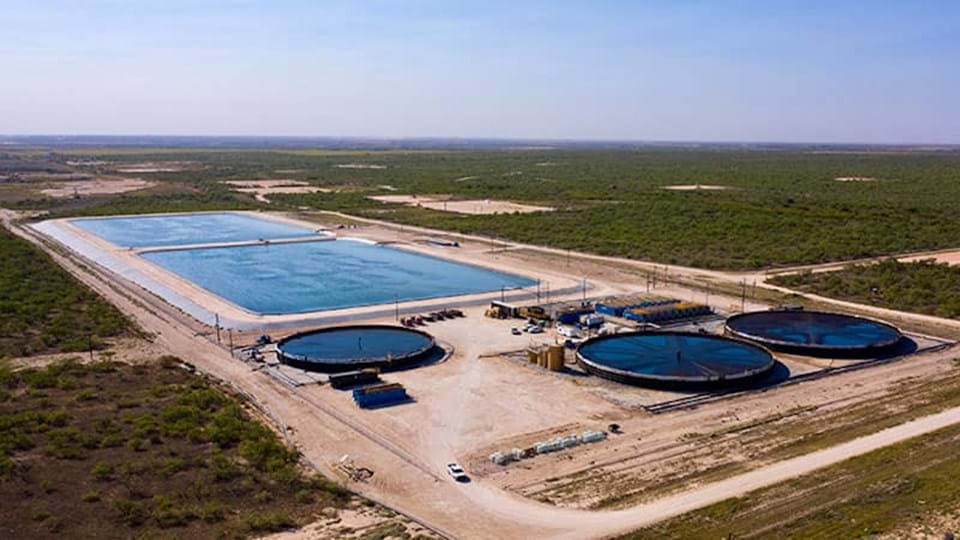
Produced water can be managed safely and cost effectively in several ways including direct injection disposal formations, treatment and injection, and treatment and reuse. These processes have fostered an entire subindustry within oil and gas to safely and responsibly dispose of produced water waste. If the produced water has low enough levels of pollutants, then it can be used for irrigation. For higher levels, treatment is required for surface discharge or reuse in hydraulic fracturing applications. In the absence of treatment, the water is injected into state approved salt-water disposal formations deep in the subsurface at depths ranging from a few thousand feet to over 10,000 feet, depending on the local geology. While the process isn’t perfect and there are occasional accidents, this is proof that large streams of waste can be safely, inexpensively, and responsibly managed.
Nuclear Waste: Safe and Manageable
Naturally occurring uranium consists of three isotopes: U-238 (99.3% by mass), U-235 (0.7% by mass), U-234 (trace) (United States Nuclear Regulatory Commission). U-235 is the fissionable product of most nuclear fuel. The level of enrichment of nuclear fuel describes the percentage of U-235. Low Enriched Uranium Fuel (LEU) has enrichment levels up to 5%. LEU is utilized in majority of reactors in the US. SNF is a byproduct of nuclear power generation, and it consists of mainly uranium, fission products, actinides, and activation products. The amount of SNF discharged from a reactor or power plant depends on the reactor type, fuel type, and fuel “burnup” or the amount of thermal energy generated per unit mass of the fuel. From a typical light-water reactor (LWR), roughly 93-95%, by mass, remains uranium as the isotope U-238, and less than 1% is U-235. This residual uranium can be recycled, although typical US reactors do not recycle fuel. The French can recycle spent nuclear fuel into mixed-oxide (MOX) fuel, which can help fuel their existing reactor fleet. U-238 has a 4.7-billion-year half-life and is little cause for concern. The National Library of Medicine (NIH) reports danger regarding naturally occurring uranium to be a concern due to its chemical toxicity, not radioactivity. This is not to say that spent nuclear fuel is not dangerous; the remaining U-235 and fission products are still radioactive and maintain extremely high temperatures.
Immediately after removal from the reactor, spent fuel assemblies are placed into large pools of water at or near the reactor site. The water provides cooling and radiation shielding, enough so that standing directly by the pool is completely safe – unless you fall into the pool and can’t swim (because you’ll drown, and drowning is quite dangerous). After a period of cooling, typically 5-10 years, the fuel is moved to dry storage casks. These are large and robust containers comprised of steel and concrete designed to contain fuel for more than 80 years and again give off little to no radiation. Both solutions are deemed by the NRC as providing “adequate protection of the public health and safety of the environment”. To date, no member of the public has been harmed by nuclear waste – ever.
Yearly, the US produces about 2,000 tons of spent nuclear fuel which, in volumetric terms, could fit on a tennis court to a height less than one meter. Since about 95% of spent nuclear fuel is U-238, which can be recycled and used in breeder reactors, the actual US nuclear waste produced annually is 5% of the total recorded spent fuel or ~100 tons. An equivalent amount of spent fuel could fit on a tennis court to an approximate height of only 4 cm. For comparison, the benzene dissolved within the yearly quantity of produced water in oil and gas extraction alone (~12,000 tons), would occupy the footprint of a tennis court up to about 50 m.



While initially spent nuclear fuel and nuclear waste require extra precautions to protect from radiation, after about 600 years spent fuel and nuclear waste have decayed enough that external radiation is no longer concern and it is perfectly safe to touch these materials. At this point nuclear waste is much more akin to the benzene and arsenic: safe to touch, but toxic to ingest.
That said, spent nuclear fuel can be treated like a resource, and advanced technologies allow for spent nuclear fuel to be recycled into new nuclear fuel and even fuel an energy source for spacecraft. This further decreases the burden of the nuclear waste stream and makes the comparison to the oil and gas industry all the starker.
A Matter of Scale
Although the type of waste varies between energy sources, when it comes to the nuclear and oil & gas industries the differences in both volume and energy density are staggering. The nuclear industry generates the most concentrated form of energy known to humanity. A single uranium fuel pellet, about the size of the tip of your finger, can produce as much electricity as a ton of coal or 149 gallons of oil. That incredible energy density means nuclear produces a fraction of the waste per unit of electricity compared to any fossil fuel.
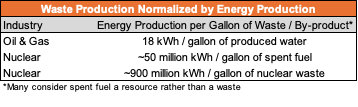
Normalizing the nuclear waste stream and the produced water production in oil and gas to the amount of energy produced by each source illustrates the incredible waste efficiency of nuclear energy. The table below shows the amount of energy produced per gallon of selected wastes from both industries.
Nuclear energy and oil and gas both produce waste, yet the type, volume, and contamination vary widely. Nuclear is notorious for its high toxicity and long lifespan, but its total volume is comparatively small and meticulously managed. On the other hand, the oil and gas industry produces enormous quantities of solid and liquid waste, yet it is regulated, managed, and few are aware of the magnitude or even presence of a waste stream.
Eighteen kilowatt-hours of energy produced per gallon of produced water pales in comparison to almost one billion kilowatt-hours produced per gallon of nuclear waste. To further put this in perspective, in 2023, the oil and gas industry accounted for about 60% of the US energy supply, which is about six times the amount of energy generated by nuclear energy (10%). However, the volume of waste in the form of produced water generated from oil and gas production was about 3.5 million times greater than the volume of spent nuclear fuel generated, which is approximately the ratio between an Olympic swimming pool and a 24-ounce tall-boy Coors Banquet beer.
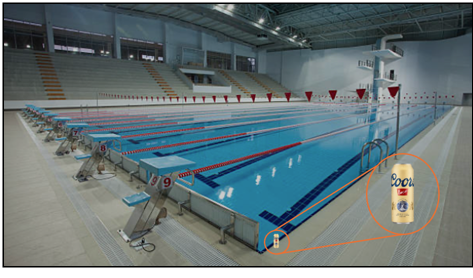
One Olympic Swimming Pool (O&G) & One 24oz Tall-Boy Coors Banquet (SNF): approximate ratio between O&G produced water generated & spent nuclear fuel generated for equivalent amounts of energy
Another good comparison is between the amount of energy generated and waste produced. As mentioned above, the oil and gas industry produce 28 billion barrels of produced water annually. This is about 1.2 trillion gallons or roughly two million Olympic swimming pools. Conversely, two thousand tons of spent nuclear fuel are produced annually in the US, filling a volume of 330,000 gallons – or about half an Olympic swimming pool.
From Doubt to Trust: Confidence is the Key
The oil and gas industry produces orders of magnitude more waste than nuclear yet continues to provide a majority of the nation's energy. Why? Because it follows regulations, manages its waste, and earn public acceptance. Nuclear does the same, yet the industry holds itself to higher, often paralyzing standards.
The bottom line is every source of energy generates waste. The question isn't what the waste is, but how it's handled. And on that front nuclear delivers the least waste per unit of energy, safely contained, never once harmed a member of the public, and in many cases recyclable or economically recoverable.
Still, nuclear faces scrutiny far beyond any other industry. Petroleum waste is largely accepted as safe unless proven otherwise, while nuclear waste is assumed dangerous until extensively proven safe.
It's time for nuclear to stop apologizing. The technology is proven. The energy is clean. The waste is controlled. The only barrier left is perception.
So, here's the challenge: will we keep letting fear block the path forward? Or will we hold nuclear to the same science-based standard we apply to every other industry? It is time to not only believe in the nuclear industry but be confident and proud. To outwardly speak not in a pleading, begging way hoping for change, but in a confident attitude that leaves no room for interpretation. This is something the oil and gas industry has mastered, and something the nuclear industry needs to learn.
But don't just take our word for it. Look into it yourself. Follow the data, not the fear, and see where it leads. If you’re not sure where to start, explore more Fire2Fission media, and join our ongoing conversation about what a nuclear future really looks like.
How to Help
1. Educate yourself: you can never properly help if you don’t understand what you are fighting for. Make sure you understand the waste produced by all industries. Utilize data to understand the risks, advantageous, and make informed decisions.
2. Speak up: start conversations with friends, family, neighbors, and strangers. People fear what they don’t understand. Use your knowledge to help them understand the realities of spent nuclear fuel.
3. Reach out to your policy makers: whether that is a governor, senator, or president of a company, it is time to make your opinion heard. Support from the public is essential.
4. Donate: money will never harm a cause.
5. Be confident in yourself and your industry!
[1] Jiang, W., Xu, X., Hall, R., Zhang, Y., Carroll, K. C., Ramos, F., Engle, M. A., Lin, L., Wang, H., Sayer, M., & Xu, P. (2022). Characterization of produced water and surrounding surface water in the Permian Basin, the United States. Journal of Hazardous Materials, 430, 128409. https://doi.org/10.1016/j.jhazmat.2022.128409
Subscribe to our newsletter
Never miss an insight. Subscribe for updates on industry developments, new articles, and podcast releases
Invest with Fire2Fission