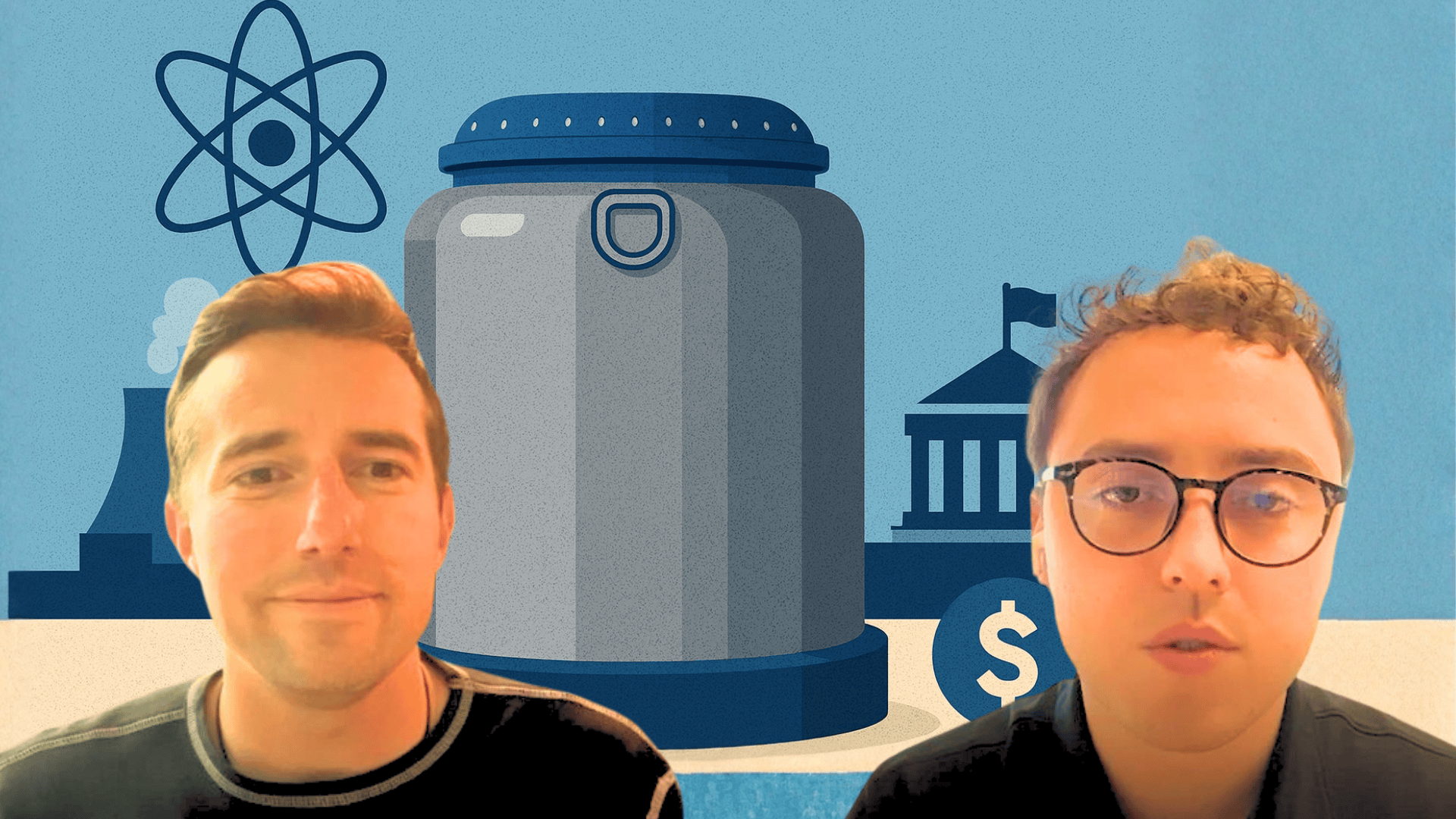
077 Sam Gibson, Hadron Energy
Transcript:
Mark Hinaman (00:00)
All right, are you guys participating in the DOE's OTA model? No, you can that.
Samuel Gibson (00:06)
No.
Yeah, we decided to not participate in this because we viewed it as a distraction, to be honest with you, because ultimately you need to have an NRC license that still hasn't changed. The NRC license is how you can deploy a reactor. So that's why we're solely focused on, all right, let's work with the NRC. Well, I'm appreciative of the effort
the DOE is putting in, I think it's great. I think we're just, are as a company, I want to prioritize however, like what it takes to get to the market, that's what we're prioritizing. And right now that's, being collaborative with the NRC. So that's what we're focused on.
Mark Hinaman (01:54)
Okay, welcome to another episode of the Fire to Fission podcast where we talk about energy dense fuels and how they can better human lives. I'm Mark Heineman and I'm joined today by my new friend, Sam Gibson, founder and CEO of Hadron Energy. Sam, how you doing?
Samuel Gibson (02:10)
doing great. Thanks so much, Mark, for having me on.
Mark Hinaman (02:12)
Yeah, you said before we started recording that you're in SF, San Francisco, or Bay Area, right?
Samuel Gibson (02:18)
Yeah, we're in the Bay Area right now. So we've got a engineering office. It's in Redwood Shores, actually right by Oracle here. I used to live in San Francisco, but recently moved to New York.
Mark Hinaman (02:30)
Okay, gotcha. Sam, we met in New York, right? I think we met first at a data center. You may not remember, I remember meeting you, but we had a data center conference. You were exhibiting, right? I hope it's a good memory. I hope they didn't ask you too hard a question. Yeah.
Samuel Gibson (02:38)
I do remember.
That's right, I do remember. Yeah.
Yeah, no, it was good. I met you at the data center conference and we had a great conversation. A lot has changed since the first time we've met.
Mark Hinaman (02:58)
Yeah, I'm excited to dig into it. So for our listeners and viewers, you want to give a quick intro about kind of what Hadron is, what you guys are trying to accomplish. And then I want to talk a little bit about your background before we talk more about Hadron.
Samuel Gibson (03:15)
Sure. Yeah. So, hey, everybody. My name is Sam Gibson. I'm the founder and CEO of Hadron Energy. And really what we're doing at the company is we are building an integral pressurized water reactor, which is pretty widely understood. And we're trying to leverage as much as we can of existing knowledge, especially when it comes to licensing. Given when I started Hadron,
I did a lot of market analysis of what's going on in the industry. And it honestly really surprised me that there wasn't a licensed microreactor out there. And when looking at, you know, the other types of companies out there, ⁓ what I found was they were mainly focused on advanced coolants or exotic fuels. And while exciting, I thought, well, there has to be a better way to get to the market more efficiently. And
Ultimately, that's why I started Hadron. And ever since we've incorporated like a year and a half ago at this point, we will now be actually a publicly traded company coming up ⁓ first half of Q1, 2026, to make us the first publicly traded light water microreactor out there. So really excited about this. And obviously, I'll get into all the dirty details shortly.
Mark Hinaman (04:38)
Yeah, nice. ⁓ Sam, did you start this? you didn't start this just right out of school. Like, what's your background? What did you study? What did you do before you got this idea to go and start this company?
Samuel Gibson (04:47)
Mm-hmm.
Yeah,
it's a great question. So my a little bit more on my background. Growing up, I'm originally from South Dakota, where, you know, we started working when we were 14. And so I've had, you know, that opportunity. I also got my driver's license when I was 14. So I think just from like a working point of view, I feel like I really got a head start pretty early in my life. And I knew from an early age, I also wanted to be an engineer because I
was inspired by Ironman as a kid. And I was like, I want to be like Ironman. So I studied mechanical engineering. I got a degree in engineering leadership from the University of Nebraska-Winkin, which was pretty close to home, but far enough away to where I could be on my own. ⁓ And then, yeah, I just was very involved in my undergrad. I was very passionate about clean energy, particularly. It's something I
Mark Hinaman (05:25)
Yes.
Samuel Gibson (05:49)
thought was very important. ⁓ When I started researching all the various types of energy, mean, nuclear was the very clear winner out of everything I studied because, you you look at solar and wind and like other renewables, geothermal, all of these things are, you know, fine, they have their use cases. But when it comes to capacity factor and actual
Mark Hinaman (06:07)
Yeah.
Samuel Gibson (06:17)
like decarbonization at scale and really making an impact. Nuclear is the best option, especially when you consider the fact that it's baseload. yeah, I think really the AI revolution, to be totally honest, really woke up the industry again and said, hey, we now need you and now public support's higher than ever. ⁓ So it really came down to just like,
being very curious about the industry, studying it very hard. I was part of a fraternity, Bay of Theta Pi, in my college days. And I also founded the American Society of Mechanical Engineers student organization on campus there. Ended up getting a couple global engineering awards through ASME. And that's how I really actually
started to get connected with a lot of amazing engineers that are much more accomplished than I was like at the time, just networking. And really these types of contacts is how I started Hadron. But, you know, after graduation, I had the opportunity to work at a startup before this that was an actual, most of my background's in HVAC. So growing up,
That's what I mostly did, commercial HVAC. And yeah, after college, I knew I wanted to start a business, but I felt it wasn't the right time to start Hadron because I had my senior thesis on the subject of basically what Hadron is today. So I just thought, well, why don't I get my entrepreneurial skills elsewhere? So ⁓ I helped start a HVAC and plumbing service business.
That was quite an interesting experience. And ⁓ I felt like gave me what I needed, the perspective I needed in order to actually build a company like Hadron. It grew from zero to $4 million in revenue in less than a year. It expanded very rapidly. And ⁓ at a certain point, I just thought to myself, I need to go chase that big thing. And that was Hadron.
Mark Hinaman (08:45)
So as you end up spinning that off or selling that business, how'd that work?
Samuel Gibson (08:48)
Yeah,
so I was like a minority or owner in the business, ⁓ I didn't really see much, you know, from like, they're still operating. And it's more so like I kind of just moved on. I wanted to just focus on what I'm doing now. And like, you know, it's it's honestly, I think it's growing. I think they're doing really well. But
Yeah, I didn't have like a lot of skin in the game there, I guess. So yeah, it's more so like me starting hadron was now I can control the ⁓ destiny of my career. I want to build something really large. And as we've kind of been chatting about, have a upcoming public listing that's valued us at one point two billion ⁓ with the capital, of course, that we have coming in. So.
Mark Hinaman (09:22)
there.
Samuel Gibson (09:48)
I mean, that's a pretty amazing upgrade. So I'm really excited about it.
Mark Hinaman (09:53)
Yeah, absolutely. We were doing $4 million a year in revenue and now we're at a billion dollar company. ⁓
Samuel Gibson (10:00)
Yes.
Mark Hinaman (10:02)
Dude, fun to hear about your early work experience. I I empathize. even like, yeah, I grew up working for my parents and working at a young age. And it's like an extra half decade to a decade of work experience that a lot of people don't get. I mean, if folks are looking online, like you're not that old, but you're doing big things as a young guy, which is inspirational and ambitious. It's awesome.
Samuel Gibson (10:19)
Thanks.
Yeah, absolutely. I agree. I it's just something I've always had the big thinking perspective and I can appreciate, you know, hard work. think it's think it's fun, honestly. ⁓ You know, especially when the mission is important. I think Hadron's mission is very important. I want to decarbonize as much as we possibly can and like eventually have a counter on the website showing how much
how many metric tons of carbon that we've saved from our deployments. Yeah.
Mark Hinaman (11:04)
Yeah.
What's the name mean? Why did you pick Hadron as a name?
Samuel Gibson (11:12)
Yeah, hadron, it's a physics term. it's a collection of quarks. It's a subatomic particle. They have very strong intermolecular forces. yeah, basically they're everywhere. I thought, well, looking through, you know, various physics terms, I thought, well, I want our energy source to be very strong and resilient and I want it to be everywhere. So that's why I went with hadron energy.
Mark Hinaman (11:41)
That is nerdy, man. I love it.
Samuel Gibson (11:43)
Yeah, yeah. Well,
and the Hadron Collider also is pretty cool. Like that's also an inspiration for me. ⁓ But yeah.
Mark Hinaman (11:56)
And for those unfamiliar,
what's the hadron colloid?
Samuel Gibson (12:00)
Yeah, so this is like a fusion ⁓ kind of experiment. And to be totally fair, I'm not like an expert in what they're doing there, but like I've done some high level research and what they do is instead of splitting the atom, they're like forcing them to collide with each other. ⁓ And it's really interesting and I'd have to look at like what they're up to now, but.
That's as far as I know right now as far as their focus.
Mark Hinaman (12:31)
Yeah,
okay, so Let's talk about the tech a little bit and I think that'll help guide some of the additional conversation but like High-level what can you share with us? I mean light water reactor Are you guys using the standard fuel? What's like the size of this thing designed and Yeah, as many details as you're happy or willing to share it was kind of an overview of tech
Samuel Gibson (12:40)
Mm-hmm.
Yeah, so this is the core part of our strategy is trying to use as many things as we can that are already existing. And the most important is the fuel. So we're using low enriched uranium plus LU plus enriched between five to 10%. And we've got suppliers here that are capable in the US to supply this. And in terms of the size itself of the reactor,
It's approximately two meters in diameter and about 10 meters tall. ⁓ And yeah, we're working on the balance of plant as we speak. So the steam turbine and generator, these are all kind of like the main priorities at the moment. But in a way, like our design is not really anything super exciting. And that's how we want it. We want it to be very, very simple.
because the whole approach I would like to have is I want the everyday person to understand what this reactor does. At the end of the day, it's just a fancy way of boiling water to produce carbon free power.
Mark Hinaman (14:13)
Thanks. Yeah. But yeah, if any of this is too specific, like, back me up. You guys, is it, I mean, pressurized water reactor, you got like multiple coolant loops, I assume then, and it's all water and like, I'm sorry, you said the dimensions.
Samuel Gibson (14:21)
But it's okay.
Yeah, from my understanding,
I'm pretty sure that we have two coolant loops. ⁓ But to be fair, I would want to verify with our engineers. this is from what I know right now. ⁓ It's meant to be, you know, it's meant to be obviously modular, meaning we can have multiple reactors in a single, like suppression pool, containment pool. So
What we're thinking is, and if you look on our website, you'll see that we've got this massive pool of water and you can line up like 10 reactors in one building. That means each building can produce about a hundred megawatts. And this gives us a lot of flexibility in producing anywhere from 10 megawatts all the way up to two to 300 megawatts ⁓ of power for, you know, a pretty wide
use case because we're talking to data centers that need 10 megawatts. We're also talking to some that need like a gigawatt. So it's pretty interesting.
Mark Hinaman (15:44)
Yeah, yeah, just log down to the website and it looks like, I mean, you scroll down, super, super cool graphics, but you've got this thing submerged in a pool. You're gonna have like multiple reactors then in the pool.
Samuel Gibson (15:57)
Yeah, they can have a shared containment pool.
Mark Hinaman (16:00)
Okay. Got
Do you envision this truly modular, right? Like, all of these reactors that you can drop in place?
Samuel Gibson (16:08)
Yeah, very modular.
We basically want to this be completely standard design that we can just mass manufacture. ⁓ Of course, the visual is like we want to have a gigafactory for the Hadron reactor. And the demand is so incredibly high for power, as you know right now. We cannot keep up even.
Mark Hinaman (16:37)
you
Samuel Gibson (16:39)
If we had reactors, like they would be sold immediately and we'll never be able to keep up with the demand. In the early days, even just like the early specs that we had, we would have customers come to us and say, if you had any reactors, we would buy them all off your shelf. And like, we got that from many different people. So it's going to take a little while for us to like build up, you know, the capacity. But.
Mark Hinaman (17:06)
you
Samuel Gibson (17:08)
You know, we're targeting our first deployment to actually generate revenue by 2029 right now is our target.
Mark Hinaman (17:14)
Nice. guess this pool, I mean having a pool like this is similar to Newscales design, right? Like the...
Samuel Gibson (17:22)
Yeah, I think it's ⁓ pretty similar, yeah.
Mark Hinaman (17:26)
Okay. ⁓ Cool.
Samuel Gibson (17:30)
Yeah. So
something for you to know, Mark, is like, basically what we're looking to do is however we can, we're looking to move most efficiently to the market. We want to really focus on commercialization and with all these new frameworks, like the NRC is very much heavily favoring micro reactors. They consider them low consequence. We can move through the process.
Mark Hinaman (17:36)
you
Thanks
Samuel Gibson (18:00)
pretty efficiently. And especially given that we're a light water design, that's what makes this whole process much more streamlined for us. So overall, when you look at, right, here's a reactor technology compared to the others, we are prioritizing speed to market. That's really what we're looking for.
Mark Hinaman (18:11)
Yes.
you
Okay, so what's your strategy then on that? kind of, I mean, you said 2029 be commercial by then, that's awesome.
Samuel Gibson (18:29)
Yeah. Yeah. So working with the NRC very extensively, we just had a nice little catch up call with them. We should have public meetings coming up with the NRC. Before the shutdown, we had more meetings that were scheduled, but obviously we had to cancel and move those. But it comes down to being very collaborative with the regulator and incorporating their feedback at the end of the day.
If they tell us something about the fuel, like we have to navigate this way with the fuel, then that's what we're gonna do because we wanna build around the model that can get approved by the NRC. that's of course what we're looking at. ⁓ And then also getting like early customers is very important. So we're working on multiple different proposals right now.
Mark Hinaman (19:12)
you
Samuel Gibson (19:27)
And that will also accelerate our time to the market.
Mark Hinaman (19:30)
Gotcha. So yeah, mean, with the NRC, like you guys have your regulatory engagement plans submitted. I think I saw an announcement from you that was like, we're posting on the website, look at that.
Samuel Gibson (19:43)
yeah. Yeah. So the regulatory engagement plan, ⁓ this one needs to be updated, the one that's currently on the NRC's website. And we are working on getting this updated with the NRC. But we've also submitted our quality assurance program description, QAPD. And then next, I believe, is our principal design criteria.
We're starting to get into some very technical documents and these kind of take some time, but luckily we have a really amazing team that on the engineering side can really feed great information into these applications. And then of course, I know if you saw this, but we are working with Andrea Vale, who was at the Nuclear Regulatory Commission for over 30 years. She was a director there.
very well known in the industry. So we're really excited to be working with her.
Mark Hinaman (20:48)
Yeah, so let's talk a little bit about, I guess she's on the team, or she joined your guys' team.
Samuel Gibson (20:55)
Yeah, so she's right now she's a more on the like contractor capacity, but she's leading our like licensing effort given we do have like, you know, Ryan Mott, our director of licensing and operations as well, who drafts, you know, a lot of our proposals. And then we have like our review team take a look. ⁓ So it's been going pretty well.
Of course, we're going to have a lot of work ahead of us, but that's one area that we're going to be expanding pretty soon as our licensing team. But so right now we have 14 full-time employees and then we have a few contractors. We've got plans to grow to about 35 to eventually about 70.
Mark Hinaman (21:35)
How big is the team? ⁓
Wow, that's ⁓ exciting times. ⁓ Are there key roles or key people that you want to bring on early? Building this company is very ambitious. Where do start?
Samuel Gibson (21:57)
Even
Yeah, it's a good question. So really, like at this point, there's many things that we have to, I mean, if you think about the critical path where we are today, there's many, many critical paths. There's the technology, there's the licensing. Exactly. So there's a lot for us to plan for. ⁓ And my job is to bring in the capital necessary, bring in the people necessary.
Mark Hinaman (22:27)
overlap and sometimes we feedback loops, right?
Samuel Gibson (22:42)
And I think we're well on our way, but really it comes down to the people at the end of the day of like who we bring into the team. And I don't know if you've seen the two most recent hires we've brought on, but Olivia Hand, we hired her from TerraPower and she's our head of reactor design right now. She has been already instrumental to
Mark Hinaman (22:44)
you
Samuel Gibson (23:11)
making a lot of improvements, which has been great. And then we also hired Tim Bussey from Metta. He actually got a nuclear engineering degree back in the day and then worked at many different energy companies and eventually worked at Metta operating their data centers. So he's got excellent connections and he's our vice president of business development. ⁓ And we're going to continue to
really strengthen our engineering team. That's going to be my main focus.
Mark Hinaman (23:45)
Let's shift gears, guess, a little bit to... And we may bounce around a little bit, Sam, but... Yeah, that business development piece. think... I don't remember if it was an announcement or if you told me in person, but like, you guys have locked in some LOIs for like folks that said, hey, well, if you had this available, like, we would buy power from you. Is that...
Samuel Gibson (23:49)
Yeah.
Yeah, exactly.
We we've we had many of these and to be totally honest, we kind of slow rolled that effort because like we could have went crazy and developed like tens and you know, hundreds of gigawatts probably have signed letter of intents for this. But what we're really focused on right now is. Let's. Focus on getting one to the market and get, you know, binding agreements, so.
Mark Hinaman (24:21)
you
Samuel Gibson (24:33)
We have these LOIs initially, but ⁓ we can actually be very selective with the customers that we're working with. And we're transitioning these initial LOIs into eventually binding purchase orders and PPAs, power purchase agreements.
Mark Hinaman (24:47)
.
But that hasn't happened yet, right? Like, you haven't converted any of those to PPAs.
Samuel Gibson (24:59)
That's correct. Yes, we're still focusing on this area and that's why we're working with Tim. ⁓ But we're working on some proposals as we speak and things are coming around. So I'm excited to see, again, we have such high demand. It's just a matter of, right, who's the best long-term partner? Because there are so many opportunities as you probably can see.
where to deploy this microreactor. And for us it's, well, we're prioritizing sort of AAA clients, if you will. And yeah, we're having a lot of those conversations right now.
Mark Hinaman (25:44)
Do the AAA clients have restrictions or their own list of requirements that their power provider has to provide? Do guys have color or insight into that?
Samuel Gibson (25:58)
Yeah,
it's always interesting. I believe, for example, like some of the big data center companies, require like 99. I think it's like four or five nines. So that means 99.999 % uptime or something like this, nearly 100%. And that for us, we do believe is achievable because say they have a plant that's
50 megawatts and we build in that extra redundancy so that they always have, for example, if they need 50 megawatts, maybe we build them 70 megawatts. And then if we ever have to refuel, we take down two reactors at a time and it doesn't affect anything. So that's basically the way that I'm looking at that.
Mark Hinaman (26:50)
Got it. Yeah, I mean, with new technology, like anytime you build new stuff, there's a chance that it doesn't work as expected the first time, right? So gotta have backup. So why did you guys pick the two megawatt electric number?
Samuel Gibson (27:08)
Yeah, this was like an early iteration. We're a 10 megawatt reactor. So the two megawatts in the beginning was a really interesting like heat pipe take on what we were going for. But now ⁓ we've pivoted to a much better design that is actually far more economical. And the 10 megawatt design that we have now is very competitive and it fits what the market's looking for as well.
Mark Hinaman (27:38)
What were, I mean, was it just total kilowatt hours out that the fuel can do? Like what were some of the things that made you decide to scale up?
Samuel Gibson (27:48)
Yeah, I mean, really the decision to scale up came down to like the cost of fuel, for example. ⁓ We do get some better economies of scale going from two to 10 megawatts. ⁓ Ultimately, it came down to getting a lot of feedback from customers. We would say, well, what's your optimal size? And a lot of the times they would say 10 megawatts, like this is.
what they would love to start with and then just grow in increments of 10. And hearing that more and more over time, just conducting more kind of discovery calls with, you know, people we want to work with. At the end of the day, that's the most important thing is, well, you know, some, some engineers build some. Exactly. Some engineers kind of just like build something super great.
Mark Hinaman (28:24)
you
Build the product, people will buy.
Samuel Gibson (28:42)
but then nobody actually buys it because that's not what they want. We wanted to just, you know, do all that hard work up front of what do these people actually want and then let's just build that.
Mark Hinaman (28:54)
smart. It's critical and does not always happen in the world. So one of my buddies has built several companies and I'm like, man, have you verified that there's like a market need for this? No, it'll be fine. It's gonna be so good that people just love it. Which is kind of like the Elon Musk model of, just make the car sexy enough that like anyone will drive it. If you build it, they will come.
Samuel Gibson (29:00)
That's right.
Bye.
Mark Hinaman (29:24)
I don't feel that arrogant to be able to make those calls. So I mean fundraising in public markets, that's going be awesome. Do you think that'll be kind of your only fundraise or you'll have to raise more or that'll be enough to get your first prototype system going? How are you guys thinking about the funding?
Samuel Gibson (29:26)
Yeah, exactly.
Mm-hmm.
Yeah, so the going public transaction for us, know, lot of the information can be found in the form S4 document that we just filed with the SEC, which is really exciting. That's a major milestone for us in bringing this to reality. But really with this, these funds, we expect to have around 300 million dollars. You know, when we go.
to become a public company and knowing this, this is going to unlock a lot of progress for us, pretty significant progress. yeah, quite honestly, I'm thinking that based on our current projections and internal workings, that this should get us through definitely on getting our license. Like that's my biggest focus is
All right, we probably need to build some sort of demonstration to incorporate data into our license application. And with this fundraise, that should cover everything ⁓ for us there. So that was really the biggest purpose was to just accelerate everything. ⁓ But yeah, I think we're definitely moving very quickly.
Mark Hinaman (31:14)
Yeah, I mean, that's impressive, right? $300 million injection. ⁓ And it's kind of that R &D cost to bridge the chasm and get licensed, yeah, to have a design that can be licensed. So would that be a prototype built, or that's just the licensing activities?
Samuel Gibson (31:35)
Yeah, so it's interesting. There's the thought of like building a prototype. There's the thought of building like a demonstration unit. What we're looking to do is build a unit that's a little bit over engineered so that we can also sell it to, you know, generate revenue as the first reactor. ⁓ So these are like discussions that we're having right now on the engineering team. But yeah, ideally,
What I don't want to have happen is we develop this prototype or sorry, we develop a prototype that like we basically never use. I want to build something that gets used. So that's really what I'm shooting for. Yeah, exactly.
Mark Hinaman (32:17)
Yeah, some more efficient use of capital, right? Hey, we just
spent a bunch of money building a shiny toy. Like, anyone want a pie? Well, I guess the next step after that.
Samuel Gibson (32:25)
And now we need to raise more, you know, yeah, exactly.
Mark Hinaman (32:35)
Would you guys be thinking like project finance? Just on kind of this business model of like, okay, well, we did the R &D work to get it licensed and now we got to go build new systems. Like, does that 300 million give you enough dry powder then to build your first next system? Or you got to like bring in more financing for that? And is that going to be debt financed? I mean, I don't know. And you could say, you know, Mark, great questions. We actually have thought about these things. We'll figure it out.
Samuel Gibson (32:47)
Mm-hmm.
No, it's we have thought about these things and ⁓ where we stand today, the 300 million should enable us to actually build subsequent plants. ⁓ And we are looking at project finance, for example. And, you know, it also comes down to getting these like signed binding agreements from customers. Once we have those, like getting financing is going to be very ⁓
straightforward, especially if they're like AAA clients, like we're saying, like someone who's very credit worthy. That's basically what we're working on. yeah, it's absolutely, it's a very important point is like, okay, what's after the first one?
Mark Hinaman (33:50)
And you said, yeah, it'd be great to build something to sell. Is that your vision that you guys are kind of the original equipment manufacturer and then you sell these things off and then someone else goes and owns them and operates them?
Samuel Gibson (34:04)
So
our model right now is HADNOR wants to be the owner operator. ⁓ Whether that means in the beginning, we partner with somebody to operate the reactor, we will still own it and just sell the power. So that's basically what we're looking at right now. And then, of course, as you grow the organization, more vertically integrated we can become. ⁓
you know, manufacture fuel, operate in-house, all these different things, manufacture in-house, like, this could be a massive organization, you know, over time.
Mark Hinaman (34:45)
Yeah, Need enough money to do all those things along the way. ⁓ Dude, going from South Dakota to New York City, like, where'd you go to school?
Samuel Gibson (34:50)
Yeah, that's it. Absolutely.
I went to Nebraska, so University of Nebraska-Lincoln. Yeah.
Mark Hinaman (35:04)
Okay, that's right, said that, yeah.
Similar to me, far enough away from your parents that like, I can still go home on the weekends if I need to, but want some separation there, yeah, yeah, yeah. How's the transition been to big city life and growing this company?
Samuel Gibson (35:13)
Yep.
Mm.
Yeah,
no, it's a good question. mean, for me, it's like I'm definitely just a big city person. I like being in the city. ⁓ I grew up in Sioux Falls, which is about 200,000 people. And, you know, it's not like necessarily huge by any means. It's ⁓ I would say a great place to grow up. But I always knew as soon as I graduated, you know, I started actually.
had drawn in the Bay Area. That's always where I wanted to start. And then as soon as I felt it was at the proper phase, I would make the jump to New York, which I recently did, of course. And yeah, I'm a huge fan of both places. It's great. ⁓ You know, we're finding some excellent talent, just making a lot of progress in general. ⁓ that's what I really enjoy.
So I'm happy with the move and it's going very well.
Mark Hinaman (36:24)
Do think fundraising efforts have been easier in New York than they would have been in SF or somewhere else?
Samuel Gibson (36:31)
It's a good question. It really depends because the thing is a lot of venture capitalists in the Bay Area are focused on like software. You know, they want to invest a really small amount and see like a thousand X in like a year or two. And it's just like pretty. ⁓
Mark Hinaman (36:49)
Yeah.
Show us your book report,
give us 50 % of your company, and here's a check for $500,000. if you're like, what?
Samuel Gibson (36:55)
Yeah, 50%. Exactly. 500. Like that doesn't get
you far at all in this industry. So yeah, we, we actually, you know, took a different route and like the venture capital scene was not ideal. And generally speaking, think maybe, you know, it's, it's not the best model in general, I think for just financing a company, I think.
more on the lines of starting with friends and family than raising from angel investors until you can start getting into larger like institutional money. That's where it's at. Because yeah, it's just much better. And that's the route that we took. And yeah, it worked out pretty well.
Mark Hinaman (37:47)
Awesome, ⁓ So are there things that you're afraid of, like big risks and like what keeps you up at night?
Samuel Gibson (38:01)
Well, I could tell you that the thing that used to keep me up at night was, you know, working on the very high priority tasks for ⁓ filing, you know, all of our important documents and just closing the SPAC deal, of course, the fund raise. That was like my most important objective. And I wanted to make sure it all went very well. But now that we're past a lot of the
Mark Hinaman (38:17)
fundraise.
Samuel Gibson (38:29)
the big milestones. ⁓ I'm more so focused on just growing the team as much as I can right now with the folks that we need to hire. And then other than that, I'm I think sleeping pretty well, which is great, but there'll probably be something down the line that, you know, I have to concern myself with. But for the time being, like
Mark Hinaman (38:49)
Yeah.
Samuel Gibson (38:57)
I think we're making a lot of great progress and we've learned a lot as a team. we're making a lot of great traction here.
Mark Hinaman (39:05)
Nice, that's awesome. You mentioned that speed to market is important to you and Paramount. All right, are you guys participating in the DOE's OTA model? No, you can that.
Samuel Gibson (39:20)
No.
Yeah, we decided to not participate in this because we viewed it as a distraction, to be honest with you, because ⁓ ultimately you need to have an NRC license that still hasn't changed. The NRC license is how you can deploy a reactor. So that's why we're solely focused on, all right, let's work with the NRC. ⁓ Well, I'm appreciative of the effort
the DOE is putting in, I think it's great. ⁓ I think we're just, are as a company, I want to prioritize however, like what it takes to get to the market, that's what we're prioritizing. And right now that's, being collaborative with the NRC. So that's what we're focused on.
Mark Hinaman (40:13)
Just
clarifying a few of those, like the DOE's program would allow you to take a reactor critical but doesn't allow you to sell electricity, right? You can't sell. So to have a commercial reactor you still need an NRC license, right?
Samuel Gibson (40:24)
You can't sell power. Yeet.
That's correct. Yeah. Yeah. You can, you can only go critical. You can't sell power. ⁓ basically the whole thought process behind it is, you know, to utilize the DOE's facilities if, if you need to, ⁓ to then extract data from the testing that you do and put that into your NRC license. That's literally all it is.
And for me, you know, we're looking at just having our own facility. You know, we control our own destiny. That's basically what we're looking at.
Mark Hinaman (41:13)
we get selected where that facility is going to be.
Samuel Gibson (41:16)
We're in the selection process right now. that's another thing that's a very fun thing. Yeah.
Mark Hinaman (41:21)
You're gonna pick
Colorado and come out skiing with us?
Samuel Gibson (41:26)
So yeah, we've narrowed it down to a few states. We'll be able to share a pretty exciting announcement there soon. unfortunately, Colorado is not in the final list, but I would still like to hit the slopes. I'm a snowboarder though, so I don't know if that's a... Yeah.
Mark Hinaman (41:44)
You're like, I'm speaking with you, If you're
watching online, I got my little Colorado sweatshirt on today. So yeah.
Samuel Gibson (41:53)
Yep.
⁓
Mark Hinaman (41:55)
Cool. And you guys probably haven't ⁓ shared first deployment locations or anything like that. But are there certain things when you're thinking about first deployments and siting and ⁓ where to go and do these things that come to mind or are priorities? How do you down select? mean, if beauties are nuclear? Presumably could put it, I think you could put it almost anywhere in the world. ⁓ Not everywhere.
Samuel Gibson (42:17)
Yeah, I mean...
Yeah, I mean, it's interesting. I think one thing that on that comment is you have to be very cautious of, what about the community, the surrounding community? If the surrounding community does not support like a reactor, you won't be able to put it in ⁓ that site. So out of the U S I believe the last time.
Mark Hinaman (42:49)
Go talk to him
and we'll convince him that it's okay.
Samuel Gibson (42:53)
Yeah, I know the more that we deploy
and I'm hoping that the sooner we can get one out there and just show how the thing works, the more support the industry will have to continue more deployments. So yeah, think there's like last time I checked about 19 states that are very pro-nuclear and we can have deployments there, of course. ⁓
There's a lot of various things to look at when selecting a site. That would be my first thing as well. Is the community going to support this? The second thing would be, what are the site characteristics? And the nice thing about microreactors is you actually have a very limited environmental impact review with the EPA, given there's basically very minimal environment.
environmental impact that the microreactor has. So that's something that's really great for us, because it reduces the timeline. ⁓ The next thing is, you know,
Mark Hinaman (44:01)
Meaning like,
it may not trigger NEPA? Or...
Samuel Gibson (44:06)
When we say this, the microreactor has just such a small footprint. For example, one of our reactors sits on 0.6 acres of land. If you compare that to a full-scale reactor that needs, obviously, an environmental review, it takes up far more land than 0.6 acres. So ⁓ that's why they have to conduct the reviews.
You look at the amount of land you're using, have to look at all the effects and everything. ⁓ So that's something that, you know, our design benefits from is actually having that.
Mark Hinaman (44:44)
Well, mean, like, microreactors
just, like, they're so little fuel, right? Like, the quantity of hazardous material compared to an oil well, frankly, or a large nuclear power plant even, is just de minimis. I guess you said you're using, like, standard fuel or LEU +, like, standard fuel rods, standard fuel bundles, like...
Samuel Gibson (44:49)
Yeah.
Right.
That's right. Yeah, we're using standard fuel rods, fuel bundles, and yeah, the suppliers that we have, produce them today so we can access these.
Mark Hinaman (45:23)
Yeah, it's just the total quantity of material. mean, Kugelmas talks a lot about this in some of the videos that he's got. It's like, this is, there is no hazard. Not no hazard, but very, very small hazard. ⁓ Cool. Sam, what else? What else is top of mind to you?
Samuel Gibson (45:37)
Yeah. ⁓
Mm-hmm.
Yeah, for me, ⁓ I'm really focused on obviously the the fundraise that we have going on in ⁓ becoming the first publicly traded light water microreactor, which will be the first half of Q1 2026. It was really coming up. mean, I know it's almost Thanksgiving and then, you know, Christmas is right around the corner and then we're going to be right there. So
Yeah, it's coming up very quickly and I'm very excited about it. So a fun fact for you will be I'm going to be the youngest founder and CEO to ever take a company public. I think the next youngest was 26 with Snapchat and I'm currently 24, which is pretty exciting.
Mark Hinaman (46:48)
Nice, yeah. Humble brag there.
Samuel Gibson (46:52)
Yeah,
no, it's something I like to share because I get asked every day of like, well, how long have you been doing this? yeah, it's just something I like to get out of it because everybody asks me. But it's good. I like it. Our team has over 150 years of experience in the nuclear industry. We're continuing to hire ⁓ very strong candidates. So these are the types of priorities that I have is putting the right
team in place and that's what we're really focused on right now.
Mark Hinaman (47:25)
Nice, cool. So being, yeah, let's build on that a little bit more. Like being so young, what do you think gave you either the ability or the gusto to go and do like maybe ignorance lists, right? Like, I don't know how hard it's gonna be, so I'll just jump in.
Samuel Gibson (47:39)
Yeah.
Yeah,
no, it's fair. you know, going through my first startup, I learned a lot, you know, just how to approach building a company and had a lot of lessons learned because, you know, what we're doing here is obviously not easy, but I figured and this is the way I think about everything is obviously anything worth doing is really hard. So
what we're doing right now, I do believe is very important work. I care a lot about decarbonization and I think clean energy is probably the most important thing to our future. So if I could contribute to that, I think that would be amazing. And I thought as well, like this is the time of my life of where I can work like if I need to.
And I feel like this has actually happened sometimes. I can work like 16 hour days. But, you know, if I'm much, much older, I might not want to do that, you know, at that time in my life. So like, this is the time in my life to where I want to chase those really big goals and see how far I can push it to then see what we can accomplish. So that's why I thought this was the perfect timing. And yeah, ⁓
Mark Hinaman (48:47)
Yeah.
Samuel Gibson (49:11)
I'm really excited about it.
Mark Hinaman (49:12)
So let's see, I like to ask the question, where do see the industry going the next five to 10 years, but I'm gonna specialize it for you. What is Hadron going to accomplish before you're 30?
Samuel Gibson (49:19)
Good night.
that's a good
question. Yeah. So.
Before I'm 30, so it'll be like six years, we'll say the things that I want to accomplish are, we're gonna have our license, we're gonna have the first unit deploy generating revenue, we're gonna have like the world-class team that can support all this work. And really, if we can accomplish just those three things alone.
within the next six years. mean, that is a very monumental achievement given there's still not a single licensed microreactor. And if we're able to do that relatively soon within the next six years ⁓ and have revenue generation, that is, think, incredibly impressive. So I would just focus on those three things. you know, anything outside of that, of course, there's we can probably squeeze more things in there, but
Those are the top three for me.
Mark Hinaman (50:29)
ambitious goals. stay focused there. thanks, Sam. It's been fantastic to chat with you. Thanks so much for for taking the time.
Samuel Gibson (50:32)
Yeah, exactly.
Yeah,
thank you, Mark. This is great.
Related Episodes
Check out the latest episodes related to this post.
.png)
.png)