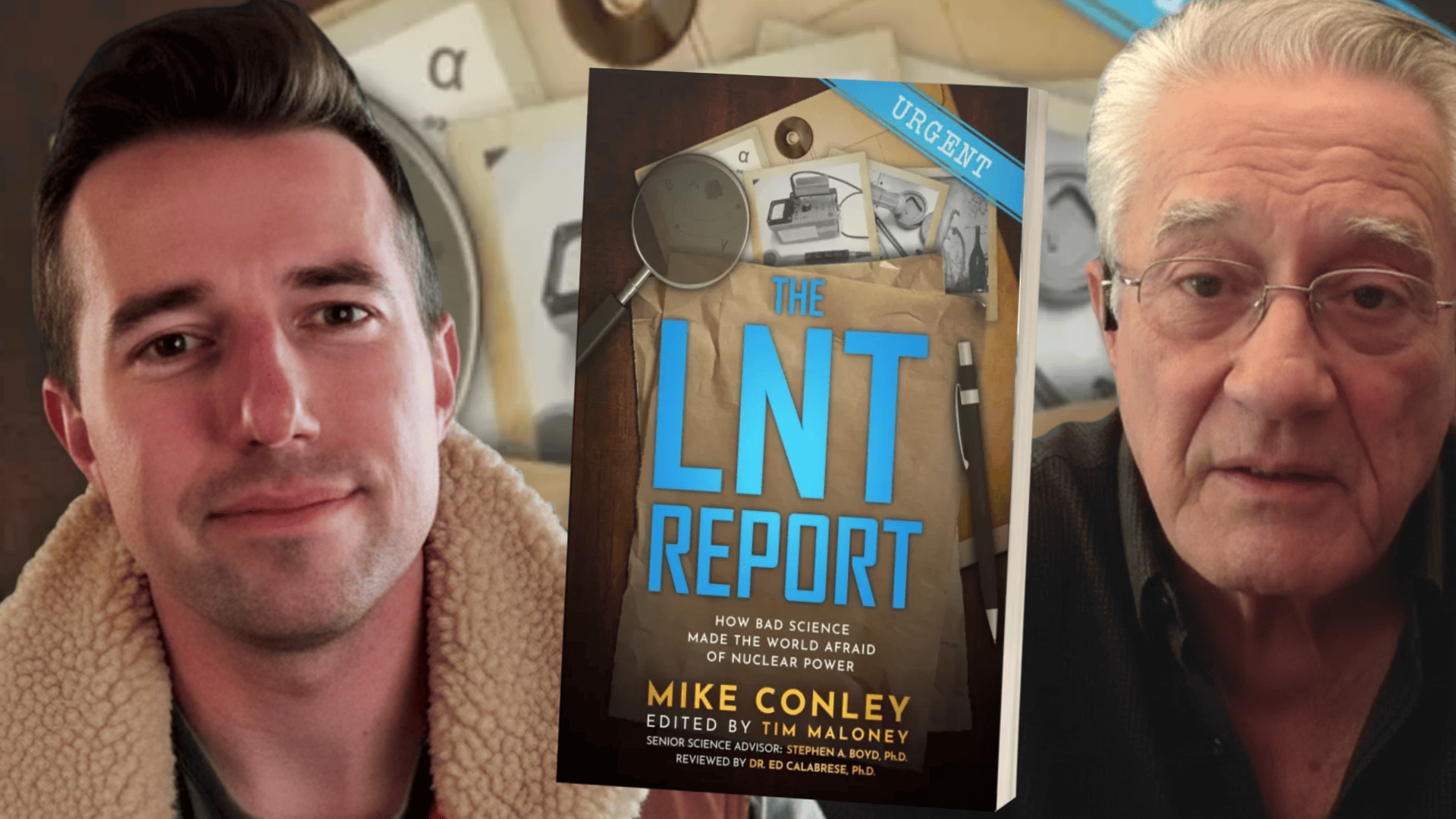
079 Mike Conley, Writer and Author of The LTN Report
Transcript:
Mike (00:00)
My good friend, Stephen Boyd, is finalizing the commercial chemistry for seawater extraction.
There's 4.5 billion tons of the ocean. No mining.
No imports, no market shenanigans, no exports, no tariffs, no trade wars. It's just go down to the ocean, filter a bunch of seawater, and then enrich that uranium here and put it in a reactor we will build here. 100 % domestically sourced fuel and power for literally thousands of years. And I'm not exaggerating.
and it is doable and the technology is there
Mark Hinaman (01:42)
All right. Welcome to another episode of the fire division podcast, where we talk about energy dense fuels and how they can better human lives. Today I'm joined by returning guest, Mike Connolly. Mike super stoked to chat with you. ⁓ we had, yeah.
Mike (01:55)
Yeah, was great. Yeah, yeah. It was so much fun the last
time. I'm looking forward to having more fun now and got a new book.
Mark Hinaman (02:03)
Yeah, yeah. talk about your book. Where else in the world can you come onto a podcast and promote books that talk about super nerdy things like linear no-threshold theory, right?
Mike (02:16)
Well, see,
I write about highfalutin things, but I write for lowfalutin people. so, you know, that's right. Yeah, I'm dude. I spent 30 years as a painting contractor and a handyman, you know, so I just write for regular people. I write to the guy in the next ladder and understand what I'm talking about.
Mark Hinaman (02:23)
Takes one to know, right? That's why we get along. ⁓
Well, Mike, in the interest of folks not having to go back and listen to the other episode, even though they should, because you're hilarious and I really enjoyed talking to you before, why don't you give folks a little bit on your background. How'd you get into writing novel, well, not novels, but yeah, stuff about technical reports and history and technical topics. ⁓
Mike (03:05)
Well, you know, I'm a writer and ⁓ I've always been kind of a nerdy guy and been into all sorts of like new technology. In fact, I've looked back on my life. Most of the writing I've done adds to our stories around new technology. I was writing. I swear to God, I was writing a novel about deep fake in 1989. I'm not exaggerating. mean, yeah, exactly. And anyway, so I was like farting around one night.
cruise in the internet and I came across the Michael ⁓ Crichton talk and I'm like, okay, I'll listen to this guy, whatever. And he blew my mind. He said, you know, he asked the audience, he goes, how many people died from the Three Mile Island meltdown? And then he looked at the audience and he said, no one. And I'm like, what? You know, and then I just got into it. And then I started reading up on thorium and molten salt reactors and,
accidents and I'm like, holy cow, this is a great technology and these scare stories are just factually incorrect. And I'm like, well, hack them. So I started making comments in online articles about nuclear power and then I was invited to join the Thorium Energy Alliance by Kim Johnson, who saw my comments and he was a chemical genius. And my good friend now, my best friend, Steven Boyd.
would follow him around with a notebook writing down chems chemistry. He would just spew it off the top of his head and Stephen would literally follow him around writing them down. Stephen is my best friend now and he's working on ⁓ uranium extraction from sea water and molten salt reactors and all that good stuff. And so I've just been writing about this stuff, you know, to explain it to people who, the class of people that I know that...
didn't understand this stuff, which are basically working class people. I grew up working class. I didn't even finish college. I should have.
Mark Hinaman (05:06)
I want to talk about several of those things, ⁓ but it never occurred to me that I could go back and look, find videos of Michael Crichton, which feels ridiculous to say out loud now. like, I love Michael Crichton. What a phenomenal author. And, know, tragic that he died relatively young. ⁓
Mike (05:21)
Yeah!
Yeah, yeah, he
did. After all the writing about all that medical stuff that he keels over, like, what was that guy that used to always talk about eating natural food? You could actually eat bark. He died of natural causes. Yeah, yeah, yeah. Anyway, ⁓ so what are we talking about here? What do you want to ask? Whip it out. Let's go.
Mark Hinaman (05:40)
You
So
who was your friend that you said?
Mike (05:52)
Stephen Boyd. Stephen Boyd is a PhD molten salt chemist, solid material chemistry, whiz-bang kind of guy. And he was Kim Johnson's protege.
Mark Hinaman (05:53)
Yeah, Steven Boyd.
Mike (06:08)
Because Ken got me into Thorough Men and the Alliance and he said, want to introduce you to my guy, Steven. And me and Steven instantly became best friends. It was really weird. We met at the airport and it's just like we hugged each other and then we're just buddies. And it's just like we just totally clicked. It's the weirdest thing. And the guy has like PhDs up at Wazoo and I never finished college. I asked him, said, why do you even bother talking to me? said, because you're a normal person that can understand what I'm talking about. And so, which is really convenient.
So anyway, I basically told all these brainiacs, you tell explain it to me and I'll explain it to the world. And the result has been three books.
Mark Hinaman (06:44)
Nice, nice. That's awesome. So, okay. Well, Mike, wait, I mean, you just published a new book. I'm holding it here in my hand, the LNT report. So. ⁓
Mike (06:45)
Yeah, that's cool.
You're almost here before. Yeah. I'll tell you about that title.
It was going to be called the other Mueller report.
Mark Hinaman (07:03)
the other molar.
Mike (07:03)
Because the book is about
Herman Muller's theories and the other Muller report would be like, you know, Mueller, Muller, ⁓ the election and I decided I didn't want to make a political, but that was how the report vibe got into this idol. But anyway, ⁓
Mark Hinaman (07:22)
I gotcha, nice. Okay. So what's, yeah, what's it about?
Mike (07:28)
Oh, it's about this L &T stuff. No,
in 98 years, this is a very interesting story. I wrote it as a true crime story because that's the way it came across to me. And I wrote it as the attempted murder of nuclear power. And so it's a page turning to true crime story, short, it's about 140 pages. You can read it literally in an afternoon. And it tells the story of how...
nuclear fear came about and how bad science made the world a fairy to nuclear power, which is the subtitle of the book. And I could tell you, I'm not sure how in depth you want to go into it, but in 1927, this guy named Herman Muller came out with an assertion that all radiation is harmful, even at the lowest, lowest, lowest doses and that all doses were cumulative.
And he came up with this idea in 1927 before we could even see what was happening inside of a cell.
And he was making claims about radiation damage. And the only evidence he had to go on was high dose damage. And the doses where he got a damaging effect were 130 million times background dose on planet Earth. And he finally got these flies coming out with five wings and green eyes. And he's like, my God.
I have unlocked the key of genetic evolution with radiation and everybody believed him. And his paper had no data, no discussion of means and methods. And it was published in Science Magazine, which was owned at the time by his professor's best friend.
Mark Hinaman (09:13)
So there's nepotism associated with us.
Mike (09:15)
I
guess you call it that. is, yeah, it's like non-biological nepotism, know? Yeah, exactly. And so people bought his assertion without evidence. in the years since that time, he worked his butt off trying to assemble evidence and he can never get it together because it doesn't exist. Because up to this day, 98 years later,
with all the science and technology we have, we have still been unable to find any objectively observable deleterious effects from radiation below 100 millisieverts a year. That's just a measurement of how much, okay?
Mark Hinaman (09:58)
Yeah, okay, so even that statement, right? Like, let's dive into that. What does that mean? No deletion.
Mike (10:05)
Okay, great. ⁓ millisievert,
a millisievert, a lot of scientists measure radiation in grays and that's the amount of radiation received by the organism. Millisievert takes into account the biological effect of the dose received. And so millisieverts are more for determining biological effects than dose and rate delivery. And anyway,
there is this threshold of 100 millisieverts. I'll give you an example of what a millisievert is. The average downwind dose from Fremont Island that flipped out the whole world was about 0.08 millisieverts. So 80 % of one millisievert. And everybody flipped out, because oh my God, radiation is scary and harmful and we're all gonna die. And it is like 80 % of 1%.
of the level of radiation that a healthy human has to receive to note any measurable deleterious effects.
Yeah. Because the big thing that people didn't understand, and it was just actually not proven in organic science, was that cells have a robust capacity to repair their own DNA damage.
Mark Hinaman (11:15)
Okay, so.
Mike (11:33)
But Muller was examining male and female reproductive cells at the moment of fusion, which is like conception. And at that particular moment in cellular life, the male sperm turns off its repair mechanism.
Mark Hinaman (11:34)
Yeah.
Mike (11:56)
Because the female handles all repairs during fusion. The DNA gets together, the two little halves, and they get together and have their happy little party, right? The female during that time does all the repair, because the male has turned off his repair mechanism. Muller was studying that moment of life, and he went, ⁓ the male has no repair mechanism, therefore all radiation is dangerous.
That's how fundamentally, ridiculously, stupidly simple this is. But that wasn't discovered, the robust repair mechanism of the male and the male turning off until the mid-50s, it wasn't verified until the 80s and 90s. And so you got to give them a little slack, but just a little.
Mark Hinaman (12:24)
Okay, so.
Hahaha
Mike (12:48)
But basically when comes to fusion, when cells like conception, like we're going to do the do and make a baby, Barbie's the boss and Cannes just can. Because the male will turn off its existing and functional repair mechanism to do the do with the lady.
Mark Hinaman (13:00)
That's great analogy.
Mike (13:12)
And if you just examine that part of life, you're going, my God, the poor guy just didn't have a repair mechanism. And we have to regulate our regulations around the fact of the male not having a repair mechanism, which is false, which is where we get this all radiation is dangerous and where we get this, we're to spend $80 billion to clean up this particle that fell in a parking lot.
Mark Hinaman (13:34)
Yeah, that's crazy. So you this term a couple of times, deleterious effect. What?
Mike (13:37)
Yeah, it is. It's Deleterious. Oh,
I'm sorry. I being too erudite? A bad effect that's objectively measurable that is like, look, that happened from radiation and did not happen from all this other stuff that happened in the cell because there's a lot of stuff happening in a cell 24-7. I'll give you an example. A normal, healthy, living cell, human or otherwise, will repair its own DNA about 10
thousand times a day.
Mark Hinaman (14:11)
this one cell, each cell.
Mike (14:12)
Yeah,
each cell. So there's literally trillions of DNA repair events happening in our body every second of the day. And you're going to go in there and go, yeah, see that damage was radiation, whereas this damage was oxidation.
Mark Hinaman (14:28)
I guess we know that radiation causes damage, but to say that that specific moment in dose and whatnot caused damage to DNA and caused injury or cancer to someone else is hard to identify cause, right?
Mike (14:32)
Mm-hmm.
Yeah, yeah, yeah, yeah.
Well, radiation
does cause damage, but it is repaired by a normal healthy cell. And this is provable by the simple fact of the matter that billions of years ago, there was far more radiation on this planet than it is now. And living cells somehow muddled through, didn't they? Because if they didn't, we wouldn't even freaking be here having this discussion on a computer that was built by humans and robots. That were built by humans. And we're back to like...
Obviously cells have self-repair or we wouldn't freaking be here.
Mark Hinaman (15:22)
Yeah. Yeah.
Mike (15:23)
Okay? And so it's like,
where does all this nuclear fear come from? You know, well, the button was largely pushed in 1920s to 30s science fiction, death rays, and scientists playing God. And then nuclear power came along. It was like, wow, scientists are playing God. They're breaking the building blocks of the universe apart and making other building blocks out of them. Holy cow, that's scary.
Mark Hinaman (15:47)
Yeah. I would argue like it, people don't get to experiment with it very often either. Right. Like, yeah. Radiation. Yeah.
Mike (15:56)
which the radiation.
Well, yeah, because it
can be harmful to humans. so the experiment on insects and animals like mice and flies. And the problem with nuclear regulations is that they don't run experiments on humans because we shouldn't. And we don't, to my knowledge. And therefore, we have to use other animals and zap them with radiation and see what happens to figure out what happened to us. And it's an imperfect system.
And there's been this precautionary principle built around nuclear power where you assume it is dangerous until proven otherwise. And what I'm saying is after 100 years of search, we should flip it around, prove that it's dangerous. And in the meantime, we'll keep using it because after 100 years, no one's found the danger that you claim. So back the hell off.
Mark Hinaman (16:55)
Yeah. I love the attitude and the rhetoric. Couldn't agree more. That's why I have to have you say it. So I'm not the only one that seems like, well, I was going to say it seems like so strong-willed about it. Yeah.
Mike (16:58)
Well, thank you. I have more attitudes if you like. Yeah, but.
Well, you know, I'm just tired of pussy flitting around. You know, the thing is, is the Green Movement has been banging on nuclear power from the get-go and it's kind of like, okay, you guys have been bitching about this for 50 years. Where is your objective verifiable independently sourced evidence of harm? It could happen. So we have to be cautious. know, okay. You know.
⁓ At a certain point, it just becomes silly and intellectually objectionable because it's not predicated on sanity, it's predicated on fear. And then when you look for the substance behind it, they don't have it, but they save you, but it could happen. And so you would be remiss if you were to slack off on this possibility.
And then you have to look at the larger picture. Well, if we slack off and we back, I'm sorry.
Mark Hinaman (18:15)
So when you're saying they,
when you're saying they, Mike, in this instance, you're like referring to like
Mike (18:20)
Well, they incorporated,
yeah.
Mark Hinaman (18:23)
or
like Sierra Club or Greenpeace or any of these NGOs that like anti-nuclear, right? They come off as environmental blobs, but they're very anti-nuclear.
Mike (18:26)
yeah, yeah, yeah, exactly. Any people that are really overly... Yeah.
Yes, exactly. you start digging into these people's rationale and you have arguments with them online and you see what they present and it's like, you bought that? You you bought that there was a million deaths from Chernobyl that were covered up in some government plot. Really? Yeah. I have a sound stage where we landed on the moon that I could sell you. You know, it's it's how far do you want to take this?
And they wouldn't take it all the way to the wall. They're still going ape about Three Mile Island and the average downwind dose proven, measured, objectively determined was less than the radiation you receive from one chest x-ray. That's the average dose, 0.08 millisieverts. The highest dose was 1.1 millisieverts, so okay.
Mark Hinaman (19:21)
Yeah.
Mike (19:29)
1.1 chest X-rays.
And that destroyed nuclear power just about.
in the 1970s.
Mark Hinaman (19:39)
So,
all right, you said people still believe that there was some government cover-up from Chernobyl.
Mike (19:46)
They have to be there has to be because like how would you explain a million deaths that are claimed to have occurred that have not been found?
Mark Hinaman (19:58)
Yeah, like you can't find any epidemiological studies that show evidence. Like no, you know.
Mike (19:58)
in the record.
Yeah. Well, see, that's the problem with epidemiological studies. Yeah. The problem
with epidemiological studies is we're going to survey like a million people downwind from Chernobyl and see what the cancer rate is and was and all this other stuff. And it's like there's so many other things that cause cancer. 30 percent of adults die of cancer. And so the downwind people from Chernobyl, when they start dying of cancer, is like, my God, Chernobyl did that. Well,
All of a sudden, the only reason why you die of cancer is radiation. What about the other 30 % is like, oh no, radiation, you know, and it isn't looked at holistically. And there are statistical estimates of how many deaths should occur based on the flawed assumption that there was no safe dose. And so there's estimates of 4,000 dead or a million dead or whatever. We're all based on
measuring what went down when and okay if there's no safe dose there's a million people down when and all the stuff went down there divided up among a million people how many of them will die?
And it is a intellectual exercise that is backed up by real world observation.
Mark Hinaman (21:19)
Which is, yeah.
Mike (21:19)
In fact,
one little more factoid, the downwind section of Chernobyl, Bryansk, the most heavily dust in the area, Bryansk, now has a 15 % lower cancer rate than the general population.
Mark Hinaman (21:35)
It helps just add radiation, right?
Mike (21:38)
Yeah,
exactly. Well, see, that's the thing. People are saying radiation is good for you. Well, yes and no. A bee sting is good to a beekeeper before the season because it up regulates his immune system against bee stings. vaccines don't make you healthy. They prevent you from getting sick. Radiation doesn't make you better. It proofs up your small doses. Will proof up your body the way a vaccine will.
to upregulate your defense system. And of course you can take enough vaccine and get sick and die. And some people get sick and die from vaccines because of whatever. And okay, fine, there might be one in 10 million people that you give them a little boats of radiation and they keel over, but that doesn't mean you back off from a global technology that is produced just in America alone. 27 trillion kilowatt hours with 16 casualties in 70 years.
and only six of them are related to radiation. 10 were just construction accidents.
Mark Hinaman (22:43)
So I hadn't heard this number before, 16 casualties in the new
Mike (22:46)
Yeah, in the American
nuclear power in 70 years, commercial American nuclear power has had 16 casualties. 10 were construction accidents. Could have happened in any industry. Three were experimental reactor melted down in Idaho in 1961, the EBR-1. Okay. And three guys died as an experimental reactor on a facility 50 miles, literally 50 miles from nowhere.
And then the other three casualties were fuel processing facilities, somebody got zapped or whatever in making fuel for reactors processing it. And so if you just take a look at the radiation related casualties, six and 70 years.
You get dozens of people dying from falling off of windmills and roofs, installing solar panels every year, just like those 10 construction deaths. And yeah, you don't have the radiation deaths in wind and solar, but you have to look at the casualties per terawatt hour of energy produced. And when you look at that nuclear is by far
Mark Hinaman (23:36)
Yeah, I think.
Mike (24:01)
safer than anything else and wind and solar are right there with it and I think they're a little higher because of the maintenance deaths.
Mark Hinaman (24:11)
Yeah, it's pretty crazy.
⁓ I think he said EBR. I think that was SL1, right? That murders.
Mike (24:17)
yeah, SL1, was the EBR1
is the, ⁓ I forget all the, man, Nuke guys just love the rap with that soup. I can't keep up with this stuff.
Mark Hinaman (24:25)
Yeah,
All good. ⁓ If anyone doesn't know the SL1 story, it's interesting. I was just in Idaho. They're like, there's the true story and what they repeat at INL and a little bit of the lore. ⁓ So fascinating kind of stuff behind it. But also like, what a phenomenal track record. the industry, let's shift gears a little bit. The industry may...
say, well, you we've only hurt 16 people because of our phenomenal safety record and our safety culture. And that may be true, but I would say like the causal piece, at least on the radiation side, is like the physics and the technology is just inherently not as dangerous as other activities that we do. Do you think...
Mike (25:02)
Mm-hmm. Mm-hmm.
It's just simply it's not. People,
for example, they're freaked out about used fuel, Nuclear waste. It's only waste if you waste it. Okay? Used fuel, after 600 years, has no gamma emission. What's that? That's the radiation that jumps out of a thing and zaps you from a distance. That's gone in 600 years. All right? After that, you have to literally crush it into a powder and snort it.
to have radiation there. No, because you can't even because it goes right through you.
Mark Hinaman (25:43)
I'd eat it, but yeah,
I like that. I'd crush it into a powder and snort it. ⁓
Mike (25:49)
But it's true, it's true because okay,
let's take a look at a used fuel pellet. It's not water soluble. So if the cabin floods, it's not gonna like wash all this nasty stuff to the surface.
See, you this pellet 600 years later and like it, you can just do like this all day long, put it up against your cheek, you're not gonna get no zappies. You have to get it in because your skin protects you from stuff. You have to get it inside your body and keep it there. Well, how are you gonna do that? You can eat it or you can snort it. Well, if you eat it, goes right through you because your body doesn't use uranium. And any of the strontium and the...
and when cesium that would have radioactive in ages past after 600 years is just regular strontium, regular cesium that is found in nature and you have to eat a lot of that you're probably gonna get sick. So you have to snort it.
And then you have it up against your lung tissue and it zaps you like the polonium 210 and cigarette smoke. And maybe after 30 years you'll get cancer. And so you get 600 years later, you got these guys breaking into this super secret nuclear fuel cavern. And it isn't even warm because I have ton of use fuel pellets after 600 years generates 1.7 watts of heat.
So you're not going to drag it up to the surface and make a ⁓ winter blanket with it. You might want to stay in the cave for a winter because it's cold. And you can snort the stuff to get high and you won't. You'll just get like radiation sickness 30 years later or whatever. And everybody's flipped out about used fuel. And I quite frankly think I've been thinking about this and deep geologic repositories are dug for billions of dollars below the water table and all the caverns are there and the little canisters.
and his pack with bentonite clay and it's like, it's performative.
Casts, surface casts last for a hundred years. Just put it in a series of six casts and you can literally physically actually put it back into the mind from whence it came and will be no more radioactive than the mind.
Mark Hinaman (28:06)
Yeah.
Brilliant, that's it, you're done. ⁓
Mike (28:09)
Yeah, it's true. And people are like, oh my God, use fuel and it's going to cost all this money and we can't afford it and it's expensive.
It's like for help. I will not cuss on your show. I'm sorry. After 600 years, you have to work on making get hurt you.
Mark Hinaman (28:21)
You can curse all you want.
Yeah, yeah. To be clear, Mike, it's my show. You can tell us all you want. ⁓
Mike (28:34)
I tend to blab. I have the gift of blab. And then my fingers do the talking and then you're a writer. It's real simple.
Mark Hinaman (28:38)
I like it.
And then
you're a writer. ⁓ So I think you also just answered ⁓ something that Brett Kugelmass had been asking the industry for a long time. I think he had a standing ⁓ bet or offer that if somebody could, and I forget the exact mechanics of this, but it was like, hey, tell me actually how like the radioactive nucleides are going to hurt you or cause damage or harm.
Mike (28:55)
That's it.
Mark Hinaman (29:13)
and I'll give you $10,000." And it was like, ⁓ he said, one's actually taking them up on it. It's like really hard or impossible to prove it. So I gotta go back and find it.
Mike (29:20)
Wow.
Well, when I get rich,
I'll do the same thing. I'll tack it to the door of the NAS, you know, like Martin Luther. Show me the freaking evidence, bro. It's really goddamn simple. Show me the evidence. I am willing to entertain your theory if you show me the evidence. It's dangerous. Okay.
Mark Hinaman (29:28)
I'm
Yeah.
Yeah.
Mike (29:51)
Here we go again. Show me the 98 years and they're still going at it.
Mark Hinaman (29:51)
You
So do you, Mike, do you engage with many people in the nuclear industry, like engineers and
Mike (30:00)
No, they can't stand
me. No, no, I'm kidding. ⁓ We get along fine. ⁓ Mostly with ⁓ scientists and other advocates and ⁓ reactor designers, ⁓ fuel designers. So yeah, I interact with a lot of these people. Actually, I do, know.
Mark Hinaman (30:03)
safety people.
just wonder,
the culture is fascinating. There is a lot of like, well, we're just, we're going to submit to the regulator and we're going to do what they tell us to do. And the regulator is following these rules because of all these frustrations that have, because of, yeah, the LNT, right? In this book, and it feels kind
Mike (30:38)
You know.
Yeah, the attention
should be on reforming the regulations.
Mark Hinaman (30:47)
Yeah. But like from the people that are actively working and designing these things, like, I don't know, it, feels like there could be, more pushback could be more. I'll say more education kind of about this topic, this specific topic. Right. So.
Mike (31:01)
Well, here's the thing. American nuclear.
I'm sorry, I'll repeat that please.
Mark Hinaman (31:12)
So think there could be a bit more education about this specific topic ⁓ within the nuclear industry, right? Like people like from regulators, people that are working to try and get new licenses, approvals, like I think the whole industry could be a bit more educated. So I think it's actually, I think everyone within the industry should read your book.
Mike (31:29)
Yes, exactly.
Well, I agree, you know, and we're trying to get the books into the ⁓ electrical brotherhood worker, whatever those guys that the SEIU or whatever they call the guys, the electrical dudes that run power plants, nuclear plants, these books should be available so they can explain to their friends, this is why you shouldn't flip out that I work at a nuclear plant.
American legislators, they need to have their staff read it so they understand the issue. know, because basically what it comes down to is L &T is the bottleneck. OK, it is the bottleneck. And it must be destroyed and it can only be destroyed. I'm sorry.
Mark Hinaman (32:19)
Let's expand.
It can only be destroyed now.
Mike (32:25)
It must be destroyed. It must be debunked because it is the bottleneck. And our challenge, the challenge of the New Community Assistance is like, look, you guys have had this precautionary principle for a hundred years predicated on an assumption of harm.
If you can't prove harm after 98 years, you might want to change your tune. mean, it's been... Mueller came out in 1927 and said there's no safe dose of radiation. In 98 years, there has been no proven, oh my God, below 100 millisieverts, we got provable damage and it's not from anything else. It's not from oxidation, it's not from mutagens, it's...
straight up freaking radiation, bro. That has never been found. With billions of dollars and thousands of scientists, blah, blah, blah, they ain't found it. And so the burden should not be upon science proving radiation is safe. The burden should be upon science proving that radiation in low doses is actually harmful.
And you can apply a precautionary principle to a new technology like AI. Like, oh, boy, we better be precautionary about that because, well, I can see being precautionary about nuclear technologies, the new technology, but it's been around for 70 freaking years, bro. You know, how many how how many more years are we going to have? Like if you learn how to swim, how long are you going to wear water wings?
Mark Hinaman (33:40)
So we should.
Mike (34:07)
could drown. Yes, you could drown. Yes, you could. I don't see any swimmers wearing water wings. Mark Luganis doesn't go in his pool and put on water wings because he has proven to not be susceptible to drowning.
Mark Hinaman (34:11)
you
Mike (34:29)
Because there's an absence of evidence of him being drowning prone.
Mark Hinaman (34:36)
So how do we reverse this?
Mike (34:38)
Just bitch-slapping until they wake up. No, I mean, you got to put out stuff like L &T and just be upfront and say, well, great, let's have a discussion. Let's have a conversation, not a debate. I'm not going to have debates, but I will have conversations all day long. Yeah, you want to just talk with nuclear? Fine. You know, if you want to get into some one-up smear presidential debate, like throwing barbs at each other, I have no freaking interest. But you wouldn't talk about it all day long.
Mark Hinaman (34:51)
There's no debate.
Mike (35:07)
And it's it's real simple. Show me the evidence. Well, with something so dangerous, you have to be precautionary no matter how, even if there is a lack of evidence. Well, that's a suppressive society. We have 27 trillion kilowatts with 16 casualties, 10 of which are construction accidents, and you're flipping out over a chest X-ray. Let's get undiplomatic about this. No one will ever build a reactor like Chernobyl again. And people are still talking about Chernobyl.
Well, I don't, excuse me, but you pick up any car magazine and there's not a headline discussion about the Ford Pinto making everybody 50 years later afraid of automobiles because everybody knows that no one's going to build an exporting gas tank like that again.
Mark Hinaman (35:54)
We learn from these things and we move on.
Mike (35:56)
And we don't
learn from nuclear Chernobyl was the ford pinto of nuclear reactors. Chillax, they can build one again. And so all the nasty statistics about all this other stuff is like, yes, that was a cautionary tale. We will not do that again. Let's move on. No, we can't move on. We have to worry about this.
Mark Hinaman (36:15)
Yeah. It feels like almost a dogma, like religious. Yeah.
Mike (36:20)
Yes, it is. It's a belief. Yeah. And the thing
is, is belief in the absence of evidence is anti-scientific, is unscientific. is against, it is against the enlightenment. is.
Mark Hinaman (36:31)
I mean, believing
is seeing, right? I mean, this is kind of like what, you know, people would say, it's faith. You just have to believe that it's dangerous and then it's dangerous.
Mike (36:41)
Yeah,
yeah, that you have to, well, 1957, Ed Lewis in front of the Joint Congressional Committee, he was the one that came out and said that radiation can cause cancer. And cancer is a genetic deformity within a cell within your body, not a reproductive deformity that you could pass on to your children. So he was saying, Mueller was saying, you gotta protect the reproductive cells, okay?
And then Ed Lewis took his bad theories and applied it to all cells of the body, the non-reproductive cells of the called the somatic or body cells. Then he said, yeah, well, radiation cause cancer too. So you get zapped and you're screwed, you know. And what he said in Congress was specifically this. Congress said, well, we all know the high radiation is dangerous, but how low is low enough, Dr. Lewis? And he said, well, we have
provable linear effects in the high dose zone here. So we should, well, this is just my personal opinion, your honors. And this is like he said, it was his personal opinion. We should assume a linear response in the low dose range. That is what he said to Congress. We should assume.
harm in the low dose range because you saw in the high dose range, even though we can't find it in the low dose range. He actually said that in June 13, 1957 to a joint congressional hearing of Congress and they're like, my God, radiation. Like that. Is it? Yes. In high doses, it is absolutely harmful. Do not mess around with that.
But he's like, my God, bananas, we're all gonna die, you Sorry.
Mark Hinaman (38:29)
So is there.
⁓ Is there a different model like at the lower doses? mean, I Vania at updates for this S curve, right? Yep.
Mike (38:40)
Yeah. Jack Tavati's working on it. Ed
Calabrese is working on it. Ed Calabrese has what's not a model, but a concept for a model. Where you superimpose the linear theory, the threshold theory, and the hormetic theory, it's in the book. And then you blend all those three graphs together and you strike up a compromise that all three camps can accept.
It's in the book, it's in the last chapter. And it's a concept for a model. And Jack Devaney has an actual model, and it's called SNT, sigmoid, no threshold, and it's not about sigmoidoscopies. So don't worry about that. ⁓ A sigmoid is an S-shaped curve, that's all it means, S-sigmoid. He should have called it it anyway. And his idea is, great, let's measure radiation received at a nuclear accident.
and compensate people according to the grades of the millisievers that were recorded to have been received by them. And so with Three Mile Island, it'd be, oh, you got 0.08 millisievers? Oh, here's a free copy of Earth as a nuclear planet. Yeah, but I was freaked out. Oh, okay, here's a copy of the Olentia report. You know, that's it. Yeah, and so you...
And then you can have the actuarial tables reflect that and insurers can come up with a rational way of insuring power plants instead of operating from the assumption that there is no, well, there's no safe dose that obviously no expense must be spared and no expense has been spared, which is why everybody goes, nuclear is expensive. They make South Korea and China routinely build large light water reactors.
in today's dollars for about $25 to $3,500 in installed kilowatt. Voho costs $16,000 in installed kilowatt.
My solution is simply this. The US hires South Korea to build an APR 1400 reactor on US soil on the condition that we were to watch every single thing that everybody on their crew does from soup to nuts. And that costs us an extra half billion, it's worth it. The reactor I'm talking about is approved for construction on US soil. The APR 1400 is the same reactor they built at the UAE.
United Arab Emirates, right? Same reactor. We can build a USO, just hire Kepko to come over here and give them like five billion instead of 15 billion to the guys that built Vogel and then have the guys that built Vogel get to sit around on their butts for the next five years and watch what these guys do until they get the hang of it. I want somebody to explain to me why that is not a good idea.
Mark Hinaman (41:37)
I think it's a great idea. It's fascinating. Aren't we trying to like get Korea to invest in America anyway? commit investment dollars?
Mike (41:45)
Well, they're trying to. Yeah.
And yeah. And then the whole night that plan got raided by the ice goons. And then Korea is like, yeah, you want to come over there and build something? Screw you. Yeah. Look what happened the last time. You know, it's like, don't get me started about the Trump administration. Anyway, but the thing is, there is no legal barrier to a U.S. hiring South Korean to build a South Korean reactor in the United States.
on the condition that we watch everything they do so we can learn how they roll.
Mark Hinaman (42:20)
Do do it?
Mike (42:22)
I'm they might say yes on the condition that you don't change the rules and regulations to make us do stupid shit when we already started. I'll give you an example. Vogel is 300 miles from the coast. On a river and after Fukushima, we had to do a bunch of reef retrofits on Vogel and mid construction because of tsunami fears.
Mark Hinaman (42:46)
That's just crazy.
Mike (42:47)
That's just freaking
straight up stupid. And anybody at the NRC that wants to argue with me, I'd be glad to do it because this just just freaking straight up stupid. And it costs all sorts of money and all sorts of time. It's like, Rick, nuclear costs a lot of money. Yeah, if you have some bonehead changing regulations in midstream for something that will never occur. Germany flipped out about Fukushima and decided to get out of nuclear. Were they afraid of tsunamis in the Baltic?
Mark Hinaman (43:00)
Have
Mike (43:18)
This is atavistic fear. This is nuclear fear. It doesn't have any basis of rationality or logic. And it is a gross, pathetic exaggeration of some very real and very understandable fears that people do have.
Mark Hinaman (43:37)
Yeah. So Mike, with the book, you wrote it in this true crime prose. ⁓ Why? Tell us about that. Tell us about if there's, you know.
Mike (43:49)
Well, here's what he
did is Ed Calabrese is like the world's acknowledged historical researcher on the subject of Valentin. There's nobody that's done research like he has. So he put out this series of 11 hours of an interview and I watched him five times because what I discovered was the interview was about
different nuclear topics rather than a historical linear explanation of how things came to be. But all the pieces were in the lectures. And so I just put them together in chronological order and told them with my typical sardonic flair and made it into a page turning whodunit or why they do it, how they get away with it, true crime story, which is what it is. Because I think that Mueller was criminal in his behavior.
He fucking lied. He didn't have data. He said he did, and he actively suppressed people that proved that he was wrong.
Okay. And people bought his.
Mark Hinaman (44:49)
Yeah. It was very
important. Yeah.
Mike (44:54)
And it's bad science BS. And the people bought his BS and we've been fighting it ever since. And it is the number one bottleneck to the expansion of nuclear power. And all the anti's go back to radiation is dangerous, even in small amounts. It's like, show me the fricking evidence. Well, Morris said he didn't have any evidence. His paper had no evidence.
He never replicated his experiments. He never gathered a group of experiments that proved the sweeping claims that he made. The people that say that they had evidence never presented it after saying that they would. It is all in the book. I am not exaggerating.
Mark Hinaman (45:46)
Sorry, you didn't make this up, right? ⁓
Mike (45:48)
No, I didn't make this up. It's just like it's a true crime
story. And it is. it's just like it's like this is how it came to be. This is how bad science BS made the world afraid of nuclear power. And you should be cautious. But not unduly so to the point where you don't implement the technology and use far less.
effective technologies to try to accomplish the same thing, which is what they're trying to do with wind and solar. Wind and solar is trying to back away from combustion to a pre-combustion technology. And I'm saying we need to go beyond combustion to fission. There are two starkly opposed philosophical approaches. Mark Jacobson, he is the world's proponent of 100 percent wind and solar. His plan for U.S. wind, all wind and solar grid.
I've examined it, my partner Tim have, and that's what the third book is about. because the whole philosophy is radiation is dangerous, therefore let us develop this unsuitable technology and make it work because, my God, we can't use radiation, Lord Almighty, we're all going to have five heads, therefore we must make this other thing work. And it doesn't, because it doesn't scale. And I'll tell you how it doesn't scale.
We added up how many solar panels he needs to do his program and how many would have to be replaced daily to keep his plan in operation. 460,000 full-size solar panels daily. In one week, it equals the volume of 432 Park Avenue. That's skinny white skyscraper south of Park Avenue. It's very famous now. That real skinny box, right, with the windows all around it. That volume.
of solar panel waste in 7.6 days. And it must be 100 % recycled or we will not have the silver to do the job.
Mark Hinaman (47:54)
Yeah, my question was silver, copper, conductors. ⁓
Mike (47:57)
Yeah, it's all it's all in Roadmap
to Nowhere, the third book that's coming out. basically China owns has a monopoly on rare earth and they have a monopoly on polysilicon. Polysilicon is what you print the solar cells on. think half of it is made in China and 70 percent half of it is mined in China and 70 percent of the finished polysilicon is made in China. And the rare earths are there. and it's like we
will literally need another China to implement Marc Jacobson's US wind and solar program and screw the rest of the world. I mean, it's just an unworkable concept. Why? Because it does not scale. My good friend, Stephen Boyd, is finalizing the commercial chemistry for seawater extraction.
There's 4.5 billion tons of the ocean. No mining.
No imports, no market shenanigans, no exports, no tariffs, no trade wars. It's just go down to the ocean, filter a bunch of seawater, and then enrich that uranium here and put it in a reactor we will build here. 100 % domestically sourced fuel and power for literally thousands of years. And I'm not exaggerating.
and it is doable and the technology is there and the only thing stopping it is LNT because LNT is like, that's great, but we can't do it. LNT is like, there's a monster on the porch. my God, there's a monster on the porch. So now we have to construct a trillion dollar staircase and get in through the back room window because there's a monster on the porch. And that's exactly what it is. The world has been convinced there's a monster on the porch and they're doing all these elaborate workarounds.
Mark Hinaman (49:47)
You ⁓
Mike (49:58)
And the monster is easily managed and provably contained and managed properly. And even when the monster gets out of the box, like Fukushima, no one was injured or killed from radiation. No one. It was scary as hell. my God, it was scary. my God, it was scary. But no one was injured or killed from radiation.
Mark Hinaman (49:58)
rather than.
Mike (50:28)
But my God, we have to shut down nuclear power because of Fukushima. Why? Because you were scared? Yeah, I'm scared. Turn that thing off. I mean, that's how silly it becomes. I'm sorry. I don't mean to insult anybody. Well, maybe I do. But that's how silly it becomes. It's like, I'm scared. There's no evidence. But I'm still scared. But there's no evidence. But I'm still scared. OK, fine. You know, it's just like, Humans, you know?
Mark Hinaman (50:54)
So Mike, where can I see if people can find your book on Amazon or else?
Mike (50:58)
Yes, on Amazon.
then the first, yeah, all three of them will on Amazon and ⁓ they're lots of fun to read. They're as entertaining as I am. And you'll learn something and...
Mark Hinaman (51:08)
You're
gonna read the audio version out loud folks have some of your own flair in it
Mike (51:14)
I'd like to, but I got so much stuff going on. got you won't believe I can't. don't want to brag, but I got all sorts of deals cooking right now. And I might be really busy doing some writing in a real short. That's why I got to get wicked. Excuse me. That's why I have to get road map to know where finish, because I got these screenplays coming out that people want rewrites on and deals and blah, blah, blah. And I'm like.
You know, just want to go away. I just want to sit on the porch and spit on ants. you know, anyway, read my books and my books were written specifically for regular people. I wrote these books so my sister can understand this stuff. Dear Susie, look at all this cool shit I found out about. ⁓ That's how I write the book. And then I back them up. There's five hundred end notes.
Mark Hinaman (51:43)
Nice.
Mike (52:04)
in Earth's nuclear planet. In case you're doubting what I'm saying, here they are, here's the arithmetic, here's the math, blah, blah, blah, blah, blah, you can dig as deep as you want. And I do that with all the books. Because if my plumber can't understand nuclear power, we are not gonna save this planet.
Which was that sound?
Mark Hinaman (52:25)
I like it. I like it. Mike, this has been fun.
Mike (52:30)
It's been fun. It must
have been the coffee. I'm really stoked right now. But anyway, yeah, let's do this more. If you want to dig into anything specific, do it. Let's dig. You know, it's fun. All right. All right.
Mark Hinaman (52:34)
Yeah.
Absolutely, that'd be great. ⁓
Yeah, anything else to try? No? All good. All right. Thanks Mark, see you.
Mike (52:45)
Bye bye now.
All right, I'll talk to you guys later, right?
Related Episodes
Check out the latest episodes related to this post.