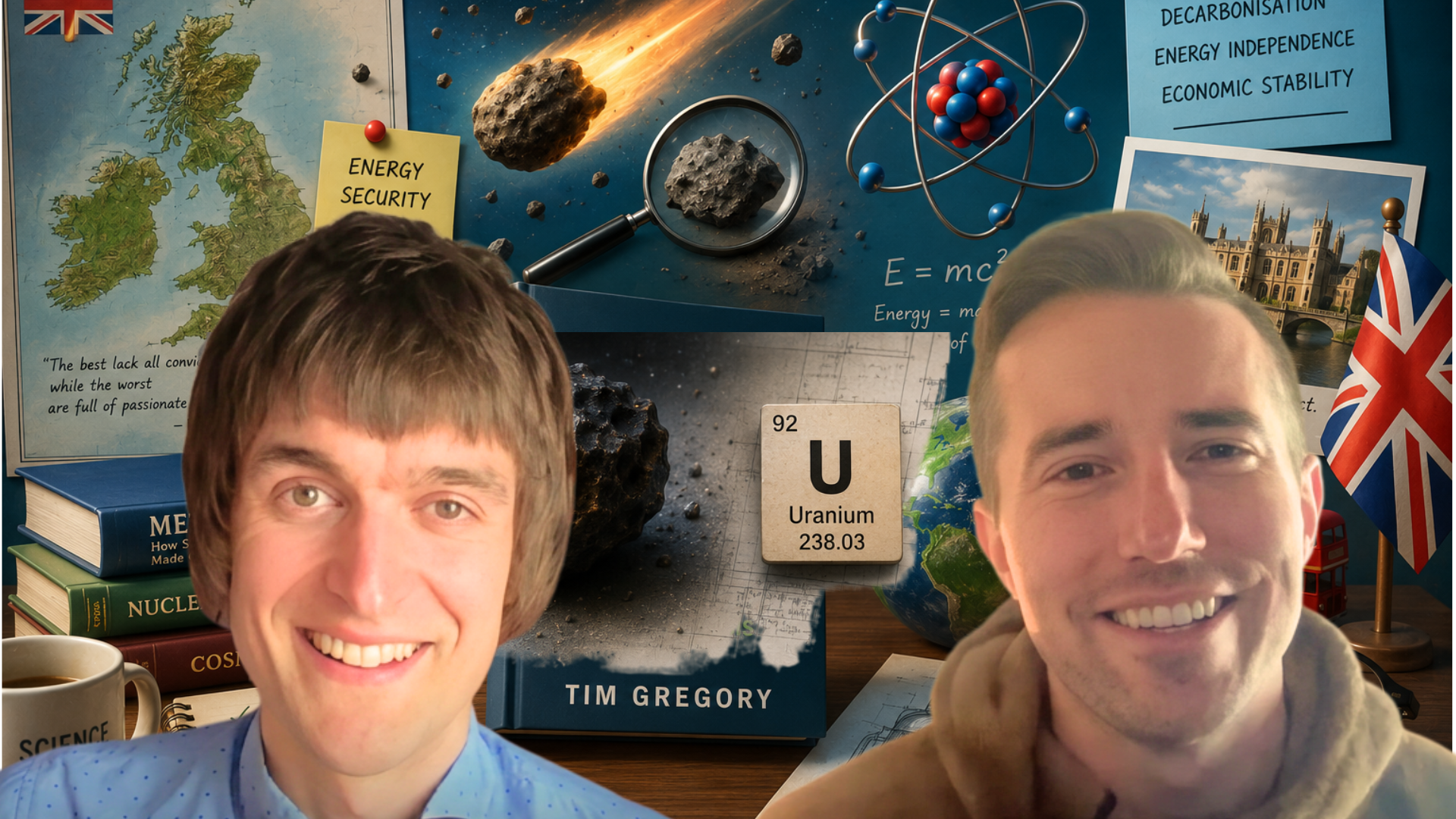
080 Dr Tim Gregory, Nuclear Chemist and Author of "Going Nuclear"
Transcript:
Tim Gregory (00:00)
And I just kind of remember thinking a couple of years ago, nuclear is so obviously essential to decarbonisation and energy abundance, but it doesn't seem to be a centrepiece of proposed energy policies, let alone kind of a second or third tier. At best, it's kind of an afterthought to all of these ideas. And I thought that is just...
Mark Hinaman (00:20)
Yeah. And in some
NGO or environmental clubs, it's still a taboo.
Tim Gregory (00:26)
tell me about it, we have the same problem in
the UK and across Europe. And I was learning all of these things. All of the things that people in the nuclear world take for granted, these statistics about how much land you need to supply a million people's worth of electricity, or how little rock you need to mine from the ground to get a terawatt hour of nuclear power, or how few critical minerals.
nuclear power stations use compared to renewable energy sources and the carbon footprint of nuclear power and all of these things. I just remember constantly saying to myself, why didn't anybody tell me this? I wish I'd have known this sooner because this is so important.
Mark Hinaman (02:11)
Alright, welcome to another episode of the Fire to Fission podcast, where we talk about energy dense fuels and how they can better human lives. Today I'm joined by Tim Gregory, Dr. Tim Gregory. ⁓ He just told me his day job is he's a nuclear chemist at the UK National Nuclear Laboratory, but spends a lot of time nights, weekends, evenings, ⁓ public facing stuff, ⁓ writing and talking about all things nuclear. Tim, how you doing, man?
Tim Gregory (02:38)
Yeah, good thanks. How are you?
Mark Hinaman (02:40)
Excellent. So you're based in the UK, right?
Tim Gregory (02:43)
I am, yeah, in the rainiest part of the UK, right in the, well, the rain, yeah, it's the rainiest part of the UK, right in the, right in the northwest of England, up in Cumbria, which is, which is beautiful. It's, in my humble opinion, the most beautiful part of England. We've got the mountains and the lakes and the forests and it's just, it's gorgeous, but it rains all the time. And I know Brits say that. I know we love talking about the weather. I know we're always talking about the rain, but it really is the rainiest part of the entire country. So.
Mark Hinaman (03:06)
Yeah.
Yeah. You know, Brits, in my, like, mind's eye, the UK is not a very big country, and yet there's so many distinct parts of the country that, and everyone's very particular about, you know, where they're from.
Tim Gregory (03:11)
A little different to Colorado.
Yeah,
it's true. We have very strong regional accents and regional dialects and people can pinpoint me to the very postcode, which is kind of our equivalent of the zip code where I grew up based on the words that I use and the slight inflections in the way that I speak.
Mark Hinaman (03:29)
Yeah.
I'm sorry.
Yeah, I love it.
Well, Tim, excited to chat with you. Let's see, so you're an author, speaker, broadcaster. Tell us about yourself. How did you end up where you are today?
Tim Gregory (03:57)
It's a bit of a... I kind of ended up here by accident, if I'm being honest. There's one thing that was for sure as a kid, and that's that I wanted to be a scientist. I didn't know what kind of scientist. I just loved science in all of its different flavors. But you've got to choose something, right? And so I chose geology for my undergraduate degree. Yeah, it was...
Mark Hinaman (04:16)
⁓ nice. What a phenomenal choice.
Tim Gregory (04:20)
It's brilliant. It's amazing. I still love geology. And it was really then that kind of the public facing stuff started as well. I volunteered in the museum in Manchester, which is where I studied, kind of doing geology days for the public and sort of realized I had a bit of a knack for talking to people about science and enjoyed it as well. And so then I did a PhD in Cosmochemistry where I measured the age of the solar system using meteorites.
And the way that you do that is by measuring how much radioactive decay has taken part inside meteorites. You can see now how we're kind of getting closer to what I'm doing now as a nuclear chemist. so as part of that, I learned how to run mass spectrometers and measure isotopic ratios and trace elements in geological materials. And the main instrument that I used to do that was a mass spectrometer, which is this kind of the size of a small car.
and it splits atoms into a spectrum of masses, kind of the same way that a spectrum splits, a prism splits sunlight into a rainbow of colours. And so with mass spectrometry, I measured the edge of the solar system and amazingly and completely unexpectedly, that segued perfectly into my current job, which is using a mass spectrometer to measure all sorts of nuclear materials, mostly spent fuel, but increasingly nuclear medicines, as well as something that I'm involved with.
And so alongside all of that kind of career stuff, the public side of things kind of just grew and grew and grew. And I brought a book out at the end of my PhD called Meteorite. That was my first book. And then Going Nuclear, How the Atom Will Save the World, which is my second book, came out last summer. And so it's been a whirlwind year since then. I don't feel like my feet have touched the ground, but that's all good.
Mark Hinaman (06:09)
That's awesome,
Yeah. I want to talk about both books and I to talk about the process of writing books. to start, dude, geology, why did you pick geology? And I'll preface with my dad's geologist. think it's, according to Sheldon Cooper, Big Bang Theory, he hardly considers it a science, you know, which I think is a little unfair. But like, for me, geology is a fascinating, fascinating topic. And to the un-indoctrinated.
Tim Gregory (06:24)
Alright, cool.
You
Totally unfair.
Mark Hinaman (06:39)
like the ability of geologists to tell stories out of like pattern matching that is really kind of, so the untrained eye can seem obscure and you're like, you guys are totally making this up. You're definitely making this ⁓ up. Why geology?
Tim Gregory (06:55)
⁓ Yeah, it's amazing.
It's amazing. I don't feel like I picked geology. I feel like it picked me. Most kids are interested in rocks, And minerals and fossils. I was one of those kids and I never grew out of it. And the county in England where I grew up, Yorkshire, has got really interesting geology actually. it's one of the first books I ever remember reading. And it's this beautiful...
Mark Hinaman (07:07)
Perhaps, yeah.
Tim Gregory (07:25)
watercolour sketchbook of geological field notes of places in Yorkshire. And they were the places that my mum used to take me and my sister on holiday and out for the day on a weekend. And I'd stand and have this book, this field guide and looking at the landscape and have this book in front of me reading what the geologists saw through a geological lens. And that never really left me, I guess. Although, as I said, I've been interested in all sorts of...
different areas of science, but that's another nice thing about geology. It kind of encompasses everything. And it just happened to be the kind of the isotope chemistry, kind of geochemistry, cosmochemistry, flavor of geology that I was particularly taken with. And I've always been interested in space. mean, who isn't? And so the cosmochemistry was just the perfect subject for me as a PhD student. It was that beautiful part of the Venn diagram where space science and geology overlap. And that's where the meteorites say. And so it's just...
It's just awesome.
Mark Hinaman (08:23)
Yeah. I think, yeah, like I said, you have to do a lot of pattern matching with geology and like use a lot of imagination. I think that's one of the things that can make it interesting for children. And I mean, even adult scientists, right? Like we're all pretty imaginative, but like the amount of visualizing that you have to do to say, all right, what was this? You how could this have
Tim Gregory (08:32)
Yeah.
Yeah, you really do. I still feel like I've got that, I've got it in me, that geological kind of mindset. Yeah, I mean, we were just talking before we pressed record. This time last year, I was on my honeymoon out in Utah and the geology out there is just absolutely beautiful. ⁓ we're...
Mark Hinaman (08:52)
You're imagining if mine hasn't been crushed by society or...
Like you're like a candy
store.
Tim Gregory (09:10)
Yeah, really, like the honeymoon was really just a geolady in disguise, really. I didn't tell my wife that. It was really just an excuse to see some cool rocks.
Mark Hinaman (09:18)
Was
she aware of this before you started? Like, did she know how many rocks there were?
Tim Gregory (09:23)
Probably, I like to think
it was ⁓ kind of undercover of me but she had me figured out a long time ago. Yeah.
Mark Hinaman (09:30)
She's like, I see what's happening here. Okay. We're
going to a beach next though, buddy.
Tim Gregory (09:37)
Yeah.
Mark Hinaman (09:38)
Yeah,
you said you went to Zion and Moab though, like those are phenomenal parts of the world. Great for geologists.
Tim Gregory (09:42)
⁓ yeah,
it was unbelievable. Yeah, we actually flew into Phoenix and we spent a couple of days in Arizona and it was on my birthday. last year we walked down to the Colorado at the bottom of the Grand Canyon and then back up, which was just unbelievable. Yeah, really, it was like more than billion years back in time on that single walk. It's just stunning.
Mark Hinaman (09:55)
nice. Yeah. Talk about walking in time.
So mass spectroscopy for meteorites. I mean, that's fascinating. And I love this, like, I think you said it well, this Venn diagram of overlapping. All right, I've got this skill set, but I've got this other interest, and here's how these two things can work. I think people really underappreciate how useful that can be to, like, ⁓ reapply a skill set into another field of study. ⁓
Tim Gregory (10:31)
Yeah,
totally. you know, it makes it more difficult in some respects because when I left academia and left cosmochemistry behind and went into the kind of the nuclear world, I had to relearn all of this jargon and all this terminology. But you soon kind of realize that, you know, although different disciplines use different words, they're all describing the same thing fundamentally. And so, for example, when I was learning about transmutation,
of heavy elements inside nuclear reactors with successive neutron captures. That is exactly the same process as what occurs inside stars with the S process and the R process nuclear synthesis. It's just inside a nuclear reactor. You're just starting with uranium instead of lighter elements, but it's exactly the same process of neutron capture and it all depends on exactly the same things, half-lives, branching ratios, neutron capture cross-sections.
Really, you know, nature doesn't care what we call it. We just put all these different names on things within different disciplines of science. so whilst it was a bit of a learning curve moving into the nuclear world and having to relearn all this stuff, I actually found that kind of when you strip back the terminology and look at what's actually going on, there was a huge overlap with cosmochemistry and geochemistry. And so that was kind of an eye opener. That was really interesting. And it also comes with its advantages because
You know when you kind of feel like you grow up within a certain scientific discipline, you learn all the bad habits and you start using the jargon and the words without really thinking about it. And it's perfectly understandable that you do that because you have to communicate with your colleagues quickly. You have to use these shortcuts. You have to chunk concepts together into nifty little sound bites for a kind of rapid communication. But it does come with its disadvantages and it's sometimes difficult to see the wood for the trees.
Mark Hinaman (12:07)
Yeah.
Tim Gregory (12:28)
if you like. And so kind of coming as an outsider, kind of embracing that ignorance. And there's nothing wrong with ignorance because we're all ignorant about most things, right? I don't know anything about most things. And that's true for everybody. kind of embracing that and asking the questions, you kind of, often stumble upon things that people haven't necessarily thought of before. And you think like, could actually do this differently. And I think sometimes it's kind of difficult to see that if you're too immersed.
in the world, you kind of lose that almost naivety. I don't know what quite the right word is, there's something to that that lets you kind come up with ideas of how to do things differently. So that's been very useful, actually.
Mark Hinaman (13:12)
I agree. I'll say, I think there is also an art to being able to ask the right questions of the incumbent professionals ⁓ correctly. And by that, mean, not come off as accusational. Like, why didn't you think of it? Why have you always been doing it this way? background or history. It's yeah, you can be missing some things. so, yeah. So talk to me about the switch from Cosmochemistry to nuclear. Why? Why? When? How?
Tim Gregory (13:28)
Yes, yeah, for sure.
Yes, I loved my job. I finished my PhD in... when was it? was April 2019. I submitted my thesis. I had a month off and then started a job as a postdoc up at the British Geological Survey in Nottingham, which is kind of right as in the middle of England as you can possibly get. It's a very long way away from the sea, although not far from the sea.
on North American standards, I should add, for this audience. And I absolutely loved it. And I loved my colleagues. I'm still in touch with them now and I still get to collaborate and work with them, which is fun. But I loved my job, but the academic career structure just wasn't quite for me. I'm a little bit of a home bird. I do like living in the UK. Maybe once upon a time I would have really enjoyed traveling around the world post-doc in two years.
Mark Hinaman (14:14)
Yeah.
Tim Gregory (14:40)
here, three years there kind of thing. But I kind thought this isn't really for me. I think I need something a little more permanent. So I actually just fired up Google and Googled Mass Spectrometry Jobs UK.
Mark Hinaman (14:51)
And it worked! Oh my god!
Tim Gregory (14:52)
And that really
is it. Yeah. So this was very early 2020. I applied for this job and they were looking for someone who could run mass spectrometers and I thought I can run mass spectrometers. And I interviewed and I got the job two weeks before the UK went into lockdown with COVID, which is a very, very strange time. And so it took me a little while to start because...
as you would expect for working on a nuclear site like Sellafield where I work, which is the biggest nuclear site in Europe. You have to go through security checks, background checks, all the rest of it. It's quite a convoluted process, lots of paperwork further delayed by the global pandemic. And so then I started working there in the autumn of 2020. And I've been there ever since. And I'll have been there six years in September, which has just absolutely flown. I can't believe it.
Mark Hinaman (15:43)
Yeah, that's awesome, man. Good for you. Good old Google job search. Nice. Looking back now, are there any things that, is there anything that the site or the country did during COVID that really stand out about that you're like, man, that was silly or wow, we really nailed it on that front. I guess with kind of your work and your interaction with your work specifically and yeah. Yeah, yeah.
Tim Gregory (15:45)
Yeah. Yeah, there we go.
You mean during the pandemic? ⁓
I don't know, because I wasn't in the industry before and I didn't work in the building. yeah, it was normal for me because it was all such a big change from my old job. For one, with my old job, I could just work whenever I wanted. And I did work whenever I wanted. I worked all the time. I was never out of the lab. I used to love it. I was in at weekends, late on an evening. I absolutely loved it. But it's one of the...
Mark Hinaman (16:15)
You didn't have a reference frame, right?
Tim Gregory (16:37)
I don't know whether it's an advantage or a disadvantage of working in industry. You don't get to do that. It does slow some things down, but it does also mean that you kind of are forced to not be at work all the time. Although I found work to do outside of work with my writing and all that kind of thing, but that was different. But you know, the nuclear industry is so risk averse and you're so scared of anything going wrong ever that...
like everywhere else in the country, they had all these one way systems for the pandemic and you weren't allowed to go within certain distance of people, et cetera, et cetera. They put all these barriers up that you had to like walk around to get to different parts of the building. When those things disappeared, when the government relaxed its guidelines and all of those things disappeared from my building, that was my official end date for the pandemic actually, because I thought, well.
If the nuclear industry have said that it's safe to go and talk to your colleagues and grab a cup of tea with them at the tea bar, then it must be alright, it must be over. So that was a good litmus test.
Mark Hinaman (17:25)
Yeah.
Thanks guys.
⁓ So working on stuff outside of work, drives you, what kind of things do you write about?
Tim Gregory (17:41)
So I wrote, I'd never written anything actually before my first book. I thought I'll give this a go. Because I've always loved reading. I've always loved reading.
Yeah, I did. Yeah, I did actually. Yeah, it really was like that. I thought I'm going to write a book on meteorites because no one's done one for kind of a popular audience. You go to the astronomy section in the bookshops and there are loads of books on black holes, astrophysics, some on planetary science, but they weren't any on meteorites. And thought that's criminal because meteorites are the only way that we know about how the solar system formed. They're the only pieces of the solar system.
Mark Hinaman (18:01)
Yeah
Tim Gregory (18:20)
from four and a half billion years ago that we can get our hands on. They're the only way that we can study Mars in the laboratory, because we actually have Martian meteorites. And I thought, someone's got to do this. And so I sat out writing a book. And that just kind of happened, actually. I never thought I'd do it. I never thought I'd do it. I read it now.
Mark Hinaman (18:35)
Humble
brag here. Some people spend years writing the outlines and practicing with blog posts and you're like, no, no, just said I'm going to do it.
Tim Gregory (18:48)
Yeah,
yeah, I guess maybe it was naive of me to expect that to have happened. I probably just completely lucked out. But I had a really good literary agent who is not my literary agent anymore. I'm still in touch with him. I'm really good friends with him. And so he played a huge part in that, too. And so that was really fun. so that came out in... Meteorite came out in 2020 and then The Paperback came out in 2021.
and I said I'd never write another book. I said I'd never do it.
Mark Hinaman (19:20)
So it's too hard or why not? Why not write? Yeah.
Tim Gregory (19:22)
It was just so time consuming. It just
completely took over my life because I was finishing off my PhD at the time. I wrote that book whilst writing my PhD thesis and working all hours as a postdoc. I said, I'm not doing that again. That was just too much. And then I joined the nuclear industry. kind of like we were saying a minute ago, I was learning all this stuff and learning all these amazing things because I went in totally ignorant. I mean,
Mark Hinaman (19:26)
what I've heard people are like, my God.
Tim Gregory (19:48)
I knew what a neutron was, I knew what nuclear fission was, I knew the basics, but I was learning all this stuff thinking like, wow, this is absolutely amazing. Somebody should write a science book on this. And then I read the Richard Rhodes book, The Making of the Atomic Bomb, which is just one of the most phenomenal pieces of literature I've ever read in my life. It's just brilliant. And it's on my shelf right behind me, actually, on my sideboard there. And ⁓ I was learning all this stuff and reading all this stuff and thought, wow, someone should do...
a popular science book on this. So I started sketching out a plan for a very science driven nuclear science book. Meanwhile, I was kind of cottoning onto this kind of political side of things with energy policy and environmental policy and climate change and the price of electricity in Britain, which is the most expensive electricity in the developed world.
all of these conversations about the role of renewables. And I just kind of remember thinking a couple of years ago, nuclear is so obviously essential to decarbonisation and energy abundance, but it doesn't seem to be a centrepiece of proposed energy policies, let alone kind of a second or third tier. At best, it's kind of an afterthought to all of these ideas. And I thought that is just...
Mark Hinaman (21:11)
Yeah. And in some
NGO or environmental clubs, it's still a taboo.
Tim Gregory (21:17)
tell me about it, we have the same problem in
the UK and across Europe. And I was learning all of these things. All of the things that people in the nuclear world take for granted, these statistics about how much land you need to supply a million people's worth of electricity, or how little rock you need to mine from the ground to get a terawatt hour of nuclear power, or how few critical minerals.
nuclear power stations use compared to renewable energy sources and the carbon footprint of nuclear power and all of these things. I just remember constantly saying to myself, why didn't anybody tell me this? I wish I'd have known this sooner because this is so important. Energy policy isn't like other areas of public policy and politics. It's so fundamental to
prosperity and economic growth, enables all of the things that we all enjoy. Public services, functioning education system, and defence. All of these things rely on a well-functioning and vibrant economy. And a vibrant economy fundamentally depends on access to energy. And so this question of how do we get the energy we need with minimising the collateral damage to the environment, it was just so obvious to me that nuclear power.
is absolutely fundamental to that. But I didn't see many people in the industry, there were some, but I didn't see many people in the industry kind of saying that confidently and loudly and clearly in kind of the public space. And I thought, I would love to do that. And hopefully it will kind of encourage more people to do it as well. And so then I completely reworked the idea for this book that I had into...
Mark Hinaman (22:52)
Yeah.
Tim Gregory (23:08)
into what became Going Nuclear that took me about two and a half years to write that book. It was a slog. was difficult and I was working full time for most of the time that I wrote it as well. I did drop a day at work towards the end, but I'd already written most of it by the time I did that. And I kind of set out thinking I might be wrong about this. And so I'll...
kind of as I'm writing the book, kind of I'll treat everything as provisional that I'm going in, but actually by the end of it, my view was, yeah, kind of, although I'm still open to changing my mind, but no one's done it yet. I did kind of expect to go nuclear came out, loads of pro-renewable anti-nuclear kind of environmentalist types would come out and point out all the ways that I was wrong and I would end up looking really stupid publicly, but that hasn't happened. In fact, I've kind of, my views of...
Mark Hinaman (23:38)
Your mind was made up, man.
Tim Gregory (24:00)
I don't like using the word cemented or kind of firmly held beliefs because I'm a scientist. Everything's provisional to me. I reserve the right to change my mind about everything, which is difficult publicly actually when you put it in writing. But actually in some ways I don't think going nuclear went far enough. Actually, I think the case is even stronger than I thought it was a year ago when it came out. And so that was really fun. That was really, really fun. And I wrote it.
Mark Hinaman (24:02)
are hardened.
Tim Gregory (24:29)
most of it in this room actually that I'm speaking to you from. I got up at 5am every morning for more than two years and wrote for a couple of hours before work and then wrote for a couple of hours most evenings and then most of at least one day on a weekend. And so it was a real slog, it was a real passion project and so it's great to see it finally out in the world.
Mark Hinaman (24:44)
Yeah.
man
If you need a hobby, write a book, right? That's awesome, man. Good for you. I want to highlight this. It feels paradoxical, ⁓ but I see it continuously. People say that they feel like ⁓ people in their industry don't speak up or aren't proud enough of the work they do and highlight. ⁓
Tim Gregory (24:55)
Yep, yep, apparently.
Mark Hinaman (25:19)
the benefit that their industry provides for society. And some industries are better at this than others, but nuclear is funny to me because I agree with you, absolutely. Right. I mean, we run this podcast and run a company focused on nuclear energy. Like, but it, it provides such tremendous value for society. And yet it takes so few people to do so. Like, I think there's a fundamental imbalance in like net societal output.
per person is massive in the nuclear industry. And then like, so you're already limited with the gross number of people that you have available. ⁓ And then if you take another cut, right, what percentage of the people actually working in it want to like talk about their day job after hours or, you know, go and advocate for it or go and talk about policy with it. It's an even fewer number of people, right? So many people are like, ⁓ that's what I do for work. And, you know, I want to leave work at work, like you said, so.
Tim Gregory (26:13)
Yeah, for sure.
Yeah.
Mark Hinaman (26:18)
⁓
How do we bridge that gap? I guess that line was kind of your thinking. Or how do we bridge that gap to get people more outspoken?
Tim Gregory (26:24)
I think so. think it's, you're right,
it is a paradox because over the last 20 years, as we've paid more attention to the impact we're having on the environment, the renewable sector has done a brilliant job of advocating for itself. I mean, you just go on Google Images and type green energy and it's pages and pages of wind turbines and solar panels.
Mark Hinaman (26:51)
which is just baffling
to me. Like when I think about land use and forest use and like, I'm like, we're smothering the land with human-made objects. This is opposite of environmentalism.
Tim Gregory (26:53)
Totally.
Yeah, I know.
And
it's really, really good PR. They've done a brilliant, brilliant job.
And you think net zero and you think renewables, you think wind and solar, and the nuclear industry has spent the last 20 years kind of stood in the corner of the room quietly getting on with producing baseload power with the smallest carbon footprint of any power source, the smallest land footprint of any power source, the smallest material requirements of any power source, with a fatality rate the same as wind and solars.
and hasn't kind of stood up for itself and advocated for itself. It stood in the corner and just got on with it and kind of hoped that nobody noticed. And so...
Mark Hinaman (27:41)
feel like there
hasn't been a good feedback loop to like force people to do that. Or they've been too shy or scared or... yeah.
Tim Gregory (27:48)
I think it's the culture of the industry because it's so risk averse and so conservative. It's kind of, it's not really like in the DNA of the industry to go out there and really, really advocate for itself from the rooftops. I think that's changing now, I should say actually. This is kind of until recently, but for the last 20 years, just, yeah.
Mark Hinaman (28:09)
We've been trying, There's people like
you and me out here trying, like making a difference. And all the other podcasters and bloggers and movie makers and whatnot.
Tim Gregory (28:14)
Yeah.
Well, I think that I think that that is changing now. I think that there is kind of it's kind of funny because off the back of going nuclear, I've met a lot of people with a kind of similar worldview and similar ideas to mine and a similar outlook. You've just been the latest of many. And we're all kind of young. We're all kind of on the younger end of the spectrum. Not all of us, but most of us are kind of on the younger end of the spectrum. And so I think there's a slight generational thing here as well. I think there's kind of a newish
a newish, younger, slightly younger generation kind of moving up the industry now. We're kind of thinking, you know what, it's kind of maybe our turn to have a little bit of influence now and kind of set the agenda a little more. And we've kind of brought a new kind of confidence, if you like, to the nuclear sector and a bit more willing to go out there and advocate for it. And so one of my hopes with Right and Go in nuclear is that it would encourage other people
So not just in Britain, like where I live, but kind of everywhere, just to maybe kind of go out and kind of be a little more unapologetic and a little more confident, just to kind of go out there and talk about your job, demystify it, pull back the curtain and show people that there's nothing to hide here. This is actually a really, really positive thing for society. Nuclear technology is amazing. And it's not just energy, it's nuclear medicine too. It's nuclear forensics, it's nuclear space exploration.
and all the spin-off technologies that come from that. And so my hope with going nuclear is that it would kind of encourage a few people to do that. And I guess time will tell how much it's done that. But I'm loving seeing all of the kind of the nuclear stuff on social media now, people being a little more vocal about it. It's about time, because we've got a lot to offer society and we're barely scratching the surface.
Mark Hinaman (30:10)
Yeah. Well, I want to talk more about your book. We'll circle, but we'll start back to it. quick comment. ⁓ yeah, the younger generation. It's interesting. I think, so there was a bill, that sat in the house energy committee here in Colorado, ⁓ just last week that, you know, Colorado nuclear Alliance testified on. I helped testify for it, ⁓ pro nuclear bill and most of the opposition that testified, ⁓
Tim Gregory (30:33)
Cool.
Mark Hinaman (30:40)
frankly, were senior citizens, like over the age of 65. And I wonder if there's not like a generational hangover. This is my observation that there's a generational hangover, but that sector of people still conflate energy with weapons, meaning nuclear energy.
Tim Gregory (31:01)
I think you're totally
right. think that's probably a lot to do with it. Yeah, for sure.
Mark Hinaman (31:05)
Yeah,
and like a lot of the anti-testimony, was like, you know, they'd add in a sentence, yeah, and by the way, we make nuclear bombs out of this stuff too. And it's like, guys, that's not what we're doing here at all. So.
Tim Gregory (31:17)
Yeah.
And Three Mile Island as well and Chernobyl, they left huge scars in the public perception of nuclear power. I was born after Chernobyl, way after. I don't remember it one bit, but I speak to people in my mum's generation, ⁓ people born in the 60s. They remember it really well. you're exactly right. Chernobyl happened ⁓ right in the middle of the Cold War.
It was the mid-80s, that was peak bomb. That's when we had the most number of nuclear weapons in the world in the middle of the Cold War and then Chernobyl happened. And so I guess it's unsurprising that people have got an association between those two things in their minds. That's not to be dismissed. But it's not helpful when we're trying to decarbonize and phase away from fossil fuels. And I do wonder how many of these kind of older generation anti-nuclear...
Mark Hinaman (32:06)
Yeah.
Tim Gregory (32:16)
activists, the kind that you were kind of talking about, you know, they always throw in kind of an association with nuclear weapons. I wonder how many of them know full well that there is a big difference between nuclear weapon production and making nuclear power from reactors. But they've just been really cynical about it and kind of muddying, muddying the kind of that public education sphere and kind of, yeah.
Mark Hinaman (32:38)
It's a fear tactic, right? It's strange
to me.
Tim Gregory (32:42)
It's so cynical. It's so cynical. And it's actually counter to the aims of lots of these people because in my experience, I don't care what side of the political spectrum you fall on. Nobody wants to destroy the environment unnecessarily. Everybody loves nature. Everybody loves animals and plants and beautiful landscapes. It's a real source of kind of of of national pride in many ways. I mean, we chose to come to the US last year because of your landscapes, right?
it's just beautiful and part of the reason I live in the northwest of England is because of the landscape and nobody from any side of the political spectrum or any kind of political or ideological inclination wants to see the environment destroyed. So it's really peculiar when environmentalists are kind of ideologically anti-nuclear because it's counter to the very measures, the very reasonable measures that everybody agrees with, that they're advocating for simultaneously.
Mark Hinaman (33:33)
Yeah.
Tim Gregory (33:38)
It's completely counter to that. It's really unhelpful.
Mark Hinaman (33:41)
Yeah. All we can do is keep talking to them. Keep calling these people.
Tim Gregory (33:46)
Yeah, and you know,
there are signs of changes. So one of the kind of the more left-wing parties in this country is the Green Party. And they're actually doing incredibly well at the moment in the polls. They got a new leader last year. It's very, very popular. And they've never been more popular. They're set to do pretty well in the next election in three years, if it carries on like this. And I actually got in touch with the head office of the Green Party to ask
what is Zach Polanski's stance on nuclear power? Zach Polanski is the leader of the Green Party. And I guess predictably they gave a politician's answer. They said, well, it doesn't matter what he thinks of nuclear power because we make all of our policies from the membership. They vote on them democratically and then the winning policies make it into the manifesto. And I thought, okay, fair enough. But I've since kind of kept an ear to the ground and I've heard from people who are kind of in with the Green Party that there's a growing number of young Green members who are pro-nuclear.
And I don't think that would have been even a starter 10 years ago. And so the fact that there's kind of a fraction of the Green Party now in Britain, kind of advocating for nuclear power shows again that maybe the tide is turning. I would love to see the environmental movement become the champions of nuclear power. I would absolutely love that. It would give them a huge amount of kind of credibility and pragmatism. And I consider myself an environmentalist as well. Of course I am. I don't want to do any more damage to the environment than we have to. ⁓
And so it's disappointing to see, I do think that the tide is turning. I do think that the tide is turning.
Mark Hinaman (35:23)
I like that. I like that a lot. I'm curious on your opinion. Yeah, policy, right? I assume you're keeping your ear to the ground on obviously things that are happening in the UK, but maybe more broadly in Europe. ⁓ Can we talk about Germany and just how... ⁓ So I've got an anecdote that is like one of my favorite stories of all time. ⁓ We're sitting in Singapore, right? My wife and I.
Tim Gregory (35:40)
Yeah, Germany.
Mark Hinaman (35:54)
was like a Tuesday afternoon and we ran into these ship traders, right? So the guys like literally call and sell ships and it's what guys do in Singapore, right? And, ⁓ like proper, ⁓ brokers do they were sitting down and having some apparel spritz, you know, and the, like two in the afternoon, right? And so they called us over, made friends. We sat down and promptly had apparel spritz with them for about three hours, which was fantastic. Very fun. but yeah, one of the guys.
Tim Gregory (36:09)
OK, sounds good.
Very nice. Love an app for all spirits.
Mark Hinaman (36:22)
Several
of the guys were British. There's like a French guy and then there's a German guy and they talked, you know, they're like, well, what are you guys doing? I'm like, oh, we're getting a nuclear power and like one of the British guys looks over at his German buddy and he's like, oh yeah, nuclear power. Maybe we should shut all this down. What a great idea says the Germans, not. So it was, yeah, pretty.
Tim Gregory (36:37)
Hahaha
It's pretty jaw-dropping what's happened in Germany. For a country that's full of incredibly talented, smart, pragmatic people, that has got to be one of the biggest policy failures in Europe in recent times.
Mark Hinaman (36:58)
How did this
happen? What's your opinion? What's your view? Do have any German friends that talk about it?
Tim Gregory (37:03)
I do, yeah, yeah. I do have a couple of German friends and I do make a habit of asking German people when I meet them at conferences, what's the deal with that? What do you think about it? And it's got a really long history. This goes all the way back to the Cold War with the campaign for nuclear disarmament. And so it really, really, really predates kind of the 2011 pivot moment with Merkel after Fukushima. There was a real...
strong and popular anti-nuclear movement in Germany for many, many decades before Fukushima. And it was in the early 2000s, there was a green-red coalition in Germany, the kind of the Socialist-y and the Green Party got in power, and it was one of their policies was to phase out nuclear power over the next 20 years or so. Merkel got in. Was that 2009, 2010, something like that?
Pragmatically, she said, no, that's a bad idea because we probably need to get our fossil fuels. We have loads of nuclear power stations. They've got loads of life left in them and they're pretty good. We should carry on running them. And then Fukushima happened and there was such a kind of an organized and passionate anti-nuclear response to Fukushima across Germany that Merkel played politics, U-turn and said, actually, we will carry on with the phase out.
and they successfully achieved the phase out in 2023, if you can call it successful. I mean, a successful failure, perhaps, because Germany had to make up that extra power somehow. And in the short term, their coal consumption actually went up, killing thousands more people from the air pollution than would have otherwise died and wasting billions of euros of public money on the health care costs associated with all of that lung damage from the air pollution. And in a real
twist a real kind of piece of dark humour from the universe. Germany a few years ago started chopping down wind turbines at one of its big wind farms to get to the Lignite underneath to fire the power stations which is just, I it would be funny if it weren't so sad.
Mark Hinaman (39:21)
Yeah, the irony is weird.
Tim Gregory (39:23)
So now they have no nuclear power, or at least
they don't generate nuclear power. Germany still consumes nuclear power, but it just imports it from France instead.
Mark Hinaman (39:33)
There were some rumors of them revisiting this topic and energy security is big topic now.
Tim Gregory (39:40)
Yeah, you do see it occasionally in the press that German leaders kind of flirting with the idea of kind of rekindling some of those power stations and maybe starting some of them back up again. But it's still a really, really divisive topic in German politics. I kind of get the impression from talking to German friends and German people that I pick their brains at conferences that nuclear power is kind of as polarizing.
and as kind of as toxic as immigration is in other countries, if that kind of means anything to any listeners. mean, immigration is a real hot potato in Britain at the moment. And I think nuclear power is very similar in Germany. And it's ideological fundamentally because those nuclear power stations in Germany were awesome and they could be awesome again. I don't know how far along decommissioning and how decommissioning they all are, but
Man, wouldn't it just be cool if they kind of woke up and saw their sensors and restarted some of them, especially with energy security being such a hot topic at the moment in Europe after Russia invaded Ukraine and then more recently with the whole situation in Iran. I mean, it's kind of funny. We've kind of not funny. It's so depressing, but it's kind of there's a a dark humor to history repeating itself because it was in the early 1970s with the oil embargo.
that motivated France to go nuclear. They thought to hell with this. And the saying at the time in France went, we don't have oil, but we have ideas. And their idea was to do this enormous nuclear programme. And they built 56 reactors in just 25 years. had a complete domestic supply chain of reactor components. It was a domestic design of reactor. They even had a domestic fuel cycle. They made the entire thing from scratch. They set up all of the supply chains to support it.
They trained all of the workforce to run it and they just did it. They got on with it and did it. And at its apex in the mid noughties, France got 80 % of its electricity from nuclear power. And that was motivated by the oil crisis and the energy price hikes and the insecurity that came with it. And I just don't see that kind of leadership in Europe ⁓ actually at the moment now. There isn't a single European leader that's come out.
in response to what's going on in Iran at the moment or in response to what happened with Russia and Ukraine a couple of years ago and kind of had that grand vision of an enormous nuclear program. you know, France has only built one nuclear reactor since the year 2000. And it's still got some of the cleanest electricity in Europe. It's still got below European average electricity prices and it's
by far the biggest electricity exporter in Europe as well. It's still reaping the benefits of that decision that was made in the mid 70s. So it just kind of goes to show what longevity really sensible sound energy policy has coupled with nuclear technology. I just think what's possible now, right? That was 50 years ago that France did that. What would be possible now with the added urgency of climate change as well and cleaning up the environment and the electrification of society as well?
I just think how far France could have gone 50 years ago if electric cars were a thing, because the technology to decarbonise transport didn't exist until very recently. We could go even further today. And that's what I would love to see. Well, not just from European leaders, but leaders everywhere, because I think that's what it will take.
Mark Hinaman (43:26)
Yeah. I think my takeaway from the whole ⁓ deep dive there is there's a long feedback loop to these systems, right? It takes a long time to turn the boat. ⁓ And Germans do what they say they're going to do. That's what I've heard it succinctly summarized from one of my good friends, Mark Nelson.
Tim Gregory (43:44)
Yeah, they do, I suppose, yes.
Mark Hinaman (43:50)
When I asked him the same thing, was like, why? And he's like, Germans do what they say they're going to do, whether it's a good idea or not. Which is comical. But I mean, the thing about the here and now and the present and the actions that we need to take, it's like, keep having the conversations. Keep the topic present. ⁓ Don't let it flounder. Right? I think that's...
Tim Gregory (43:57)
Yep.
I agree and
I think trying to depoliticise it as well is really important. It's something that I've tried to do in going nuclear and in the years since it came out, I think the worst thing that could happen to nuclear power is it becomes a partisan issue. I think that was kind of it for Germany. As soon as it became a partisan issue, as soon as it became a political issue, that was it. Whereas in Britain it's just not, thankfully, that there's cross-parliamentary support from the left-wing parties all the way over to the right-wing parties and the centrist parties.
Mark Hinaman (44:30)
That's really strange, isn't it? Yeah.
Tim Gregory (44:41)
they all support nuclear power. So I would love to see some kind of
I don't know, there's some kind of agreement between parties saying, okay, just to kind of give confidence to the market and to the industry that there's going to be continuity in policy here, let's all come up with a nuclear policy that we all agree on and all agree. Because there's public support as well. There's very, very wide public support for nuclear power in lots of countries too. It's kind of a miss, it's kind of a miss, a public, another public misunderstanding that it's just really, really controversial kind of hot potato topic. And it's just not the
at all. The polling consistently shows that nuclear support is very strong in lots of countries. There are some exceptions. There was a survey that came out from Radiant Energy Group a few months ago. They do this big... right. ⁓ yeah, sure. Sorry. Yeah, of course. And they showed that one of the countries in Europe that's got the highest support for nuclear is Ukraine. And that's a country that's currently at war.
Mark Hinaman (45:30)
Yeah, Mark Nelson, right? Yeah.
Tim Gregory (45:42)
and has got Chernobyl within its national boundaries and still it's got really high support for nuclear. So I think if Ukraine can manage it, there's no excuse for the rest of us.
Mark Hinaman (45:51)
Absolutely. Yeah, the energy security thing is fascinating to me. I wonder. ⁓
just how far or how stretched people will get before they change their mind. And I think it's fascinating to me to see Germany starting to reconsider and be like, oh, maybe that wasn't such a good idea. Maybe we should restart some of our power plants. I would argue as an American that's developed a lot of oil and gas that Europe's sitting on a lot of oil and gas bounty also, if they really want true energy security, hashtag frack France. But that's not a very popular opinion.
Tim Gregory (46:16)
Yeah, we can hope and you know
Well, you know, again, I think that these things will become popular now. Energy security is really impacting people's lives. Like it's really biting. actually notice, you know, when the price of something goes up by a minuscule amount and you just, you don't even really notice. Yeah, exactly.
Mark Hinaman (46:44)
Yeah. eggs were a penny cheaper last week, but now they're, you you don't really notice, but
if it's substantial, yeah.
Tim Gregory (46:51)
They're
all rounding errors, but energy is really, really starting to bite now. It's people talking about it. Like no one talks about energy.
Mark Hinaman (46:56)
Yeah, so talk to me about the
feedback loop. mean, are your friends talking about it more? you notice it in kind of your family circles, work circles?
Tim Gregory (47:06)
Yeah,
definitely. Yeah. You see it in the news more. I check BBC News most mornings and you go on the most read little list that shows you what people are reading. It's always the energy stuff that's at the top. It's really, really biting. And I think the penny is dropping amongst, well, I think the public got there first, but the politicians are catching up that it is going to take more than building wind turbines and solar panels to achieve, first of all, net zero, but be crucially
And even more importantly, energy security and energy abundance. I think across Europe, even if there was a consensus about net zero and total decarbonisation, I don't think there was a consensus about it. But whatever consensus there was has gone now. I think this kind of net zero decarbonisation stuff that we're all really, really talking about and worrying about five years ago.
in some way seems a little bit like a luxury belief. It's a very nice thing to worry about that. And now we're actually face and now it is and now we're facing the prospects of literally not being able to keep the lights on. The carbon intensity of that electricity is the last thing on your mind when you when you when when there's no electricity to begin with or when the price is going up and up and up and up. And that that, course, feeds into the price of everything because everything needs energy.
Mark Hinaman (48:11)
It's privileged mindset.
Tim Gregory (48:36)
And so this is kind of a real crucial moment for nuclear power, in my view, politically, because again, it kind of does everything. It's as close to a silver bullet as we're going to get. And it's not perfect. And there are challenges. And yes, it's too expensive in the West and it takes too long. But you only have to look at the build times in the 70s and the 80s in North America and the 80s through the 90s in Europe and how cheaply we did it as well.
I know that it's slightly more complicated with the cost escalations in the US, but man, the French rollout, the cost barely shifted for two and a half decades as they rolled out 56 nuclear reactors. And when we look over to Asia today with South Korea, not just the reactors that they're building at home, but the four that they just built in the UAE at Baraka. And when we look over to China, I mean, the costs are falling for nuclear power and they're getting faster at it. It just shows what's possible.
when we implement this technology with sound policy and proportional regulation and an industry that's got the confidence that it's going to continue as well, not this kind of stop-start approach to nuclear policy. It's like, we are going to do this and it's going to take 20 years and we'll all reap the benefits for at least half a century thereafter. That's really, really, really what it takes. And so, yeah, maybe it will be the energy security thing that finally does it.
for nuclear. Maybe that's what it will take to make people sit up and realise that we actually need this technology. It's either that or burning loads of fossil fuels. I know what I'd prefer.
Mark Hinaman (50:10)
Yeah.
Yeah. Yeah, absolutely. Do you think the high prices are forcing people to reconsider risk tolerance, specifically in the UK? I mean, you mentioned earlier risk tolerance is ⁓ extremely low, meaning no risk tolerance whatsoever in the nuclear industry in the UK. Like, do you think that culture could shift a bit?
Tim Gregory (50:36)
Yeah, I think it will. And you know, you only have to look at the history ⁓ of nuclear power and it is impeccable safety record punctuated by a very small number of very high profile events, namely Three Mile Island, Chernobyl and Fukushima. Otherwise, it's kind of been without a hitch. You know, people talk about the next generation of nuclear reactors will be even safer than the last. I'm thinking, how could it possibly be safer than the last?
They were absolutely fine. They were absolutely fine to begin with. We don't need to strive for perfection, right? Because meanwhile, nearly 8 million people a year are dying from air pollution around the world. How about we stop that? And I think on the regulatory front, this is a real live conversation here in Britain at the moment. I don't know if you know this, but our newest nuclear power station, Hinkley Point C.
which is the first power station we've built since 1995. It started in 2017. It should have come online last year and it's still at least four or five years away. Maybe even more, I don't know. By the time it's finished, it will be the most expensive nuclear reactor in the world. It will have cost 50 billion pounds. That's about 40 billion dollars, something like that, for a single nuclear power.
Mark Hinaman (51:49)
Yeah.
Think of the other way.
Tim Gregory (52:04)
Sorry, yeah, yeah, gosh, yeah, you're right, $60 billion, it's an incredible amount of money. And so there's a real conversation in the UK at the moment about why has this happened? Is it acceptable? And should this happen again? And it's actually, I mean, it's terrible that it's happened this way, but it's also really positive in other respects because actually we have a chronic inability to build anything in Britain. And that's true across Europe.
actually as well, we're really, really bad at building infrastructure. Some countries better than others. Britain is pretty bad. We argue endlessly and consult endlessly and spend money endlessly on reports into third runways at Heathrow and high speed rail networks, new hospitals, new houses, new roads and motorways. We just can't seem to build anything. just come...
Mark Hinaman (52:56)
What cultural
artifact exists that is, I mean, why? Why does that happen? Why is the UK so bad at this?
Tim Gregory (53:03)
So I'll
give you an example of something to do with Hinckley Point C that will illustrate the point that I'm trying to make. So Britain has spent 700 million pounds, that's about a billion dollars on fish deterrent systems for Hinckley Point C. Because Hinckley Point C is on an estuary, it's on the Severn Estuary, and there are lots of fish in the Severn Estuary. And the worry was that
the intake pumps at Hinkley Point C will suck in fish and mince them and it will kill a lot of fish. And that's true, that's true. Like nothing is perfectly safe for the environment, okay? There's always going to be an environmental impact of something. The question is, what's worth mitigating and at what cost? And so Britain has spent 700 million pounds mitigating against fish being sucked into the intake pumps and being minced. And that money...
to protect a very small number of fish that are protected by the law, for example, salmon and sea trout. And there are all sorts of weird fish that I'd never heard of before I looked into this. But we've spent 700 million pounds. And you might be wondering, how many fish are we talking here? Are we talking about thousands or millions of fish a year?
The answer is no, we're talking about a few hundred fish a year, a few hundred protected fish. And you can do the back of the envelope calculation and say, okay, we've spent 700 million pounds on this, the nuclear power station. Yeah, money per fish. It depends how long you say Hinckley-Poyntsey is going to last and there's kind of uncertainty on how many fish, but it's at least something like 30,000.
Mark Hinaman (54:42)
Unit of money per fish, massive. It's the most
Tim Gregory (54:56)
pounds per fish saved. £30,000 per fish. So what's that? That's like $45,000, something like that, per fish. I mean, the total number of fish is higher, just to be clear. There will be lots of fish sucked in that aren't protected because there are lots of them, right? We don't need to protect these fish. And again, when you put the number of fish in context, it's about the same as a small fishing trawler. Okay? And so we have spent...
Mark Hinaman (55:00)
And we'll
Tim Gregory (55:23)
£700 million protecting a few hundred protected fish and in total about the same as a very very small fishing boat per year. And you've got to ask yourself is that proportionate? And I know that £700 million like compared to £50 billion it sounds like not much but it is actually a lot right? It's like it's at least a percent, it's one and a half percent of the price of the entire nuclear power station. It is not trivial.
It's not trivial at all.
Mark Hinaman (55:54)
Well, guarantee
the Chinese are not doing the same study.
Tim Gregory (55:58)
They're absolutely not. We didn't do that when we built our first generation of nuclear power stations. The French didn't do that when they built all of their pressurized water reactors. No other nuclear power station in the world has done this, and yet we have been compelled to do it by the environmental regulations in this country. And so this is another example of kind of what we're talking about with the environmental movement and environmental activists doing things that are counter to the very, very reasonable and perfectly good aims that they have.
It's very, very similar with these environmental regulations as well. And because I'm of the mind that building nuclear power stations is one of the best things that we can do for nature, actually. It's one of the most effective things that we can do. It is actually effective. It's not like paper straw environmentalism where these things that look good, but they actually have basically no impact whatsoever and they make everyone's lives inconvenient. Nuclear power station is like real stuff, man. It's like really where the rubber meets the road.
Mark Hinaman (56:53)
It'd be like spending
600 billion euros on renewable energy projects that don't actually lower carbon emissions. And this may be another
Tim Gregory (57:01)
Right, exactly, yeah.
Yeah. And
so that's the kind of culture that we're in at the moment. And there are all these different bodies, all of these different regulations that we have to meet. They all pull in different directions. There's no real coherent direction to all of this. And so it's no wonder we get nowhere. But thankfully, thankfully, and this is one of the cool things that's come off the back of going nuclear, there's a really kind of vibrant and forward looking
seen down in London of think tanks, of people who spend all day thinking about this kind of thing and drafting policy papers and scrutinising policy and running the numbers. And so one of them, Britain Remade, their whole thing is we need to get building infrastructure if we want to have a prosperous country. And these are all of the laws that stop us from doing it. And this is why we should change the laws. They've done some really great work on nuclear power. Looking for growth is another one.
Works in Progress is another one. They're all these kind of forward-looking ⁓ policy wonks who spend all day obsessing about legislation and delving into it, trying to unpick a lot of this. And actually last year, our Prime Minister, Keir Starmer, he commissioned the Nuclear Regulatory Task Force to do exactly that. And it was led by a guy called John Fingleton. There was him and a team of people that went through with a very fine-tooth comb and looked at the regulations.
that mean we just can't build nuclear infrastructure in the UK. That was published in Autumn last year and it is absolutely fantastic. I don't often recommend government commissioned reports. It's 108 pages, something like that. But it's really readable. It's brilliant. And you know when you read things and you're like, yep, I agree with that. Yep, I agree with that. Yep, I agree with that. It's one of those. And thankfully the British government have said that they're going to implement the findings from that review.
to streamline nuclear power in the future and they're going to apply the lessons learned across the entire industrial strategy in this country. And so we have to hold them to that and we have to make sure that they do do it because it's absolutely crucial, not just for building all of the houses that we need and the hospitals and the runways and the railways that we need, but also crucially for building the nuclear power stations that will give us the economic growth we need to make it all happen. And so again, I don't know, I guess it depends what day.
You ask me. I'm optimistic on the whole, there are some days where I just put my head in my hands and think, like, this is just impossible. But you can't think like that.
Mark Hinaman (59:36)
Tim, I can tell we gotta have you back on, man. This has been wonderful. We're coming up on our time Where can people find the book? You publish on Amazon or other
Tim Gregory (59:40)
Yeah, anytime. I'll let you know how it goes with the task force implementation.
You can buy it
wherever you buy your books from, anywhere. And it makes no difference to me whether it's an independent bookshop or Amazon. I don't know, actually. I don't know. ⁓ I do say that if you get a book on the bookshop stand in the airport terminal, you've made it. So if anyone sees it there, please do let me know. That would be good.
Mark Hinaman (59:56)
Denver Airport. You got a DIA?
Yeah, yeah, right.
And if folks want to reach out, the website or just LinkedIn or...
Tim Gregory (1:00:14)
Yeah, I'm on LinkedIn and you can just Google me and you can go to my website and send me an email. It goes straight to my inbox. Yeah, yeah, something like that. Yeah, you'll find me.
Mark Hinaman (1:00:18)
Dr. Tim Gregory. Nice.
Yeah,
nice. Cool. We'll link to it too. Well, Tim, this has been fantastic. Thanks so much for the time, man.
Tim Gregory (1:00:29)
Cool, my pleasure, thanks.
Related Episodes
Check out the latest episodes related to this post.