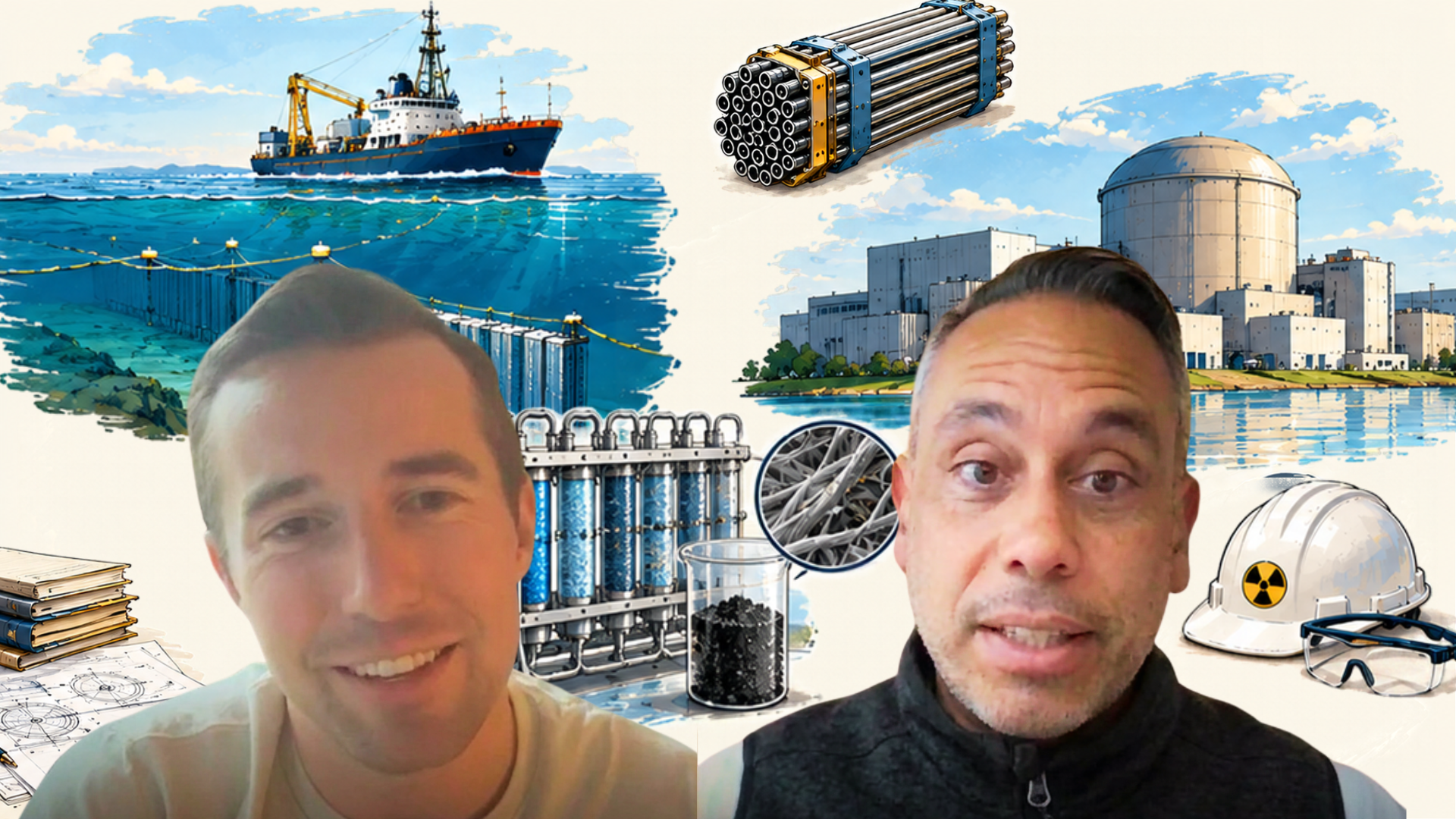
088 Canon Bryan, SuperCritical Materials
Transcript:
Canon Bryan, SuperCritical (00:00)
And put that another way, we're dependent on other countries for over ninety five percent of all the annual reactor requirements. Okay. We want to change that situation from, you know, producing less than five percent of of domestic requirements to becoming a net exporter of uranium. We want
To make the United States into a net exporter of nuclear fuels. And why wouldn't we want to do that? If we could do that, why wouldn't we? Why wouldn't we want to know where all the nuclear fuel in the world is? Why wouldn't we want to produce that and send it to our allies and sort of, you know, have that higher level control of where where these you know pro potentially proliferated fuels are going, right? That's I think that's an aspiration that we would want, just you know, as a as a
a matter of national security. So that's what we want to do. And we think that's
Mark Hinaman (00:52)
S.
Canon Bryan, SuperCritical (00:52)
with this technology, we think that's totally plausible.
Mark Hinaman (02:02)
Alright, welcome to another episode of the Fire to Vision Podcast, where we talk about energy dense fuels and how they can better human lives. Today I'm joined by my good friend, Canon Bryan, CEO of Super Critical, which is a new title for you, Canon, at least new in the kind of recent history. pretty pretty exciting times, so really stoked to talk to you today. Canon, we've been friends for I'd say several years now. I remember chatting with you like four years. Yeah.
Canon Bryan, SuperCritical (02:26)
Yeah, go going back a ways. Yeah. It's great great to be on. I appreciate the invite.
Mark Hinaman (02:30)
Yeah. So
Finally, I d I was thinking about this when we signed you up to to do the podcast and I was like, Why haven't we always cannon before? This is weird.
Canon Bryan, SuperCritical (02:39)
Everybody always says that. How
how is it that we've gone on this long as a functioning podcast without having had Ken and Bryan on? It's it's a mystery.
Mark Hinaman (02:50)
Yeah. Right? Yeah.
I love it. So Canon for the audience, why don't you g give us kind of an overview of your background and we'll certainly touch on supercritical but I wanna learn about where you came from before we
jump in.
Canon Bryan, SuperCritical (03:04)
Yeah.
so my name is Canon Bryan. amongst other things, I am the president and CEO of a new company called Supercritical Materials. I've been in finance for 32 years and gulp and sort of first ten years working as an analyst in natural resources and energy and for the past
22 years I've been an entrepreneur. I've started companies and mostly in a couple of very sort of narrow esoteric sectors, which include the following: nuclear technology, nuclear fuels, and critical metals. I have taken four companies public, three of them have gone a billion plus market caps, and I've supported the fundraising of
over five hundred million dollars for my companies, over a hundred million dollars of of government grants, and over a billion dollars of government loan and loan guarantees. so I can just briefly touch on the companies that I have birthed, given birth giv given yeah. so
Mark Hinaman (04:20)
Yeah, that's more through that's a lot of bees. Well you need
a hive for all your billions.
Canon Bryan, SuperCritical (04:28)
Ha ha
bees. there's more to come. But yes, it first started in two thousand four. group of guys and myself co founded a company called Uranium Energy Corp. Uranium was not in vogue back then, and you know, we got very lucky with timing and it's now the largest uranium mining company in the US by far. listed on the New York Stock Exchange with a market cap.
Well, depending on the day, you know, six, seven, eight, nine billion. so that was a great one. Now I can't take full responsibility for all of those billion dollars of value creation, but we were I was there on day one and we you know, we we built sort of half a billion in market value in the first you know three years. And yes, I I was indeed instrumental in that. then founded another company called Nyocorp
Mark Hinaman (05:19)
Yeah.
Canon Bryan, SuperCritical (05:21)
it was now called Nyo Corp.
which I'm very proud of. It's they're building a mine in Nebraska, the largest niobium mine outside of Brazil,
Mark Hinaman (05:31)
Yeah.
Canon Bryan, SuperCritical (05:32)
and right in the heart, I mean almost the dead geographic center of the United States. And it is just a it's a monster. It's an elephant in a mine. it's they just updated their feasibility study last week. they're now the the fe feasibility study now calls for over thirty seven
billion dollars in life of mine revenue. Just an incredible project. They sold forward a hundred percent of their production to the steel industry. they've got loans and grants from the Department of War and so on and so forth. Just an incredible company. but for the last thirteen year, most of the last
Mark Hinaman (06:10)
I just had to Google
what Niobum was used for. Yeah. Forty one atomic
Canon Bryan, SuperCritical (06:13)
Yeah.
Mark Hinaman (06:15)
used in strengthened steels and aerospace.
Canon Bryan, SuperCritical (06:17)
Yes, yes. Incredible
I mean we can have a conversation about niobium if you really want if you want to nerd out on that, have to do that later on. But Yeah, yes.
Mark Hinaman (06:25)
Yeah.
Canon Bryan, SuperCritical (06:29)
So most of the last thirteen years I've spent working on terrestrial energy and a smart company founded in two thousand twelve by myself and a couple of other dudes. And we yeah, started from zero and last year,
after you know building a I believe a world leading technology, a world leading product in the SMR the global SMR market, took the company public through a DSPAC transaction. Company raised over 300 million dollars and the company had a two and a half billion dollar market cap on day one. the SMR companies as a group have kind of declined from there, but they're down but not out by any means. I think you know they're sort of going through
the early phases of a of a new super cycle for nuclear nuclear technology. So I stepped down as CFO, a role that I had done for 13 years at Terrestrial Energy. I stepped down last May, May 2025, and to focus on my new project, well, a couple of new projects. So before I get into super critical, I'll just talk briefly about a company called Symphony Energy that I founded.
back in around 2020. we took that public last year as well on the Toronto Stock Exchange. much much smaller new issue and but I think it's got just as much ambition and aspiration to you know achieve that multi-billion dollar evaluation over time as any of my other companies. So I'm also very happy and proud to be associated with
with that company. it's ESAF on your dial on the Toronto Stock Exchange. Niobium Nioclop by the way is NB Norman Brother on or Norman Bravo on the on the Nasdaq and Uranium and Energy Club is UEC on the New York Stock Exchange. So past what's past this prologue. I've spent most of my time over the last eighteen months working on a company called Super Critical, as I said, which is
A security of supply of nuclear fuels and critical metals in the United States, primarily, where we are developing infrastructure to solve serious s supply chain constrained supply of metals in the United States, which have been facing severely dysfunctional
sort of supply chains and and market conditions for many, many years. So we can I think that's probably what we'll mostly talk about. Our our first project is an old technology that's been around kicking around for a while, developed by the Department of Energy, and that is to extract uranium from seawater and a proven technology, which was patented by the US government and super critical now
Holds an exclusive license to that patent. And we are taking that technology which is proven in the lab, more specifically in the US Department of Energy nuclear lab system, at Pacific Northwest Nuclear Labs, Oak Ridge International Labs, and universities such as MIT, University of Texas, University of Idaho, and others, and other scientific organizations including Woodshole.
Oceanographic Institute and others. And so our job is to take the technology out of the lab where it's proven and into industrial production. so doing the engineering, going through all of the first principles approach to design and engineering and construction of an industrial scale facility and proving that we can produce uranium from seawater at industrial scale and at low cost.
So there you go, long introduction, but that's that brings us up to date.
Mark Hinaman (10:44)
holistic, right? Yeah. St start to finish. I yeah, I wanna talk a lot about supercritical, 'cause that's the new stuff, but I'm curious and just to educate myself on the old stuff too, I've got couple of questions. dude, I didn't realize UEC that you had helped co found that. Like I they're one of the tickers
Canon Bryan, SuperCritical (11:02)
Mm-hmm.
Mark Hinaman (11:03)
that I follow absolutely and like they've been doing some awesome work and
Canon Bryan, SuperCritical (11:05)
Mm-hmm. You'll y you'd
be surprised where Canny Bryan springs up. Often where
Mark Hinaman (11:10)
Yeah.
Canon Bryan, SuperCritical (11:13)
often where he's least expected.
Mark Hinaman (11:15)
Yeah, yeah. It's very, very cool. Talk let's talk about terrestrial a little bit. this thirteen year journey from twenty twelve, right? The whole I mean nuke
Canon Bryan, SuperCritical (11:24)
Mm-hmm. Mm-hmm.
Mark Hinaman (11:26)
nuke industry is a rough time to get into nuclear in twenty twelve. I Yeah.
Canon Bryan, SuperCritical (11:30)
Yep. One year one year after Fukushima, not not exactly
a market darling at that time.
Mark Hinaman (11:37)
Well,
I I tell people one of the best times to start an oil company is, you know, when the price oil crashes. or really the six to twelve months before the price crashes, because then by the time the price is down, all of the services are super cheap and so your capex is really low. so if you're contrarian
Canon Bryan, SuperCritical (11:53)
Yes. Mm-hmm.
Mark Hinaman (11:57)
and a good trader, then that's an ideal situation. That might have been the s situation with my previous oil company, but you know, that aside,
Canon Bryan, SuperCritical (12:03)
Mm, mm-hmm.
Mark Hinaman (12:04)
I agree. Yeah, starting with during Fukushima
some people might looked at you like you're crazy. but ta talk to me about this just the journey going through that thirteen year cycle and the difference between then and now how it evolved. Yeah. Tell tell me the story.
Canon Bryan, SuperCritical (12:26)
Sure, yeah. So when I mean when we first started this, first of all I have to say that in the five years prior to starting Terrestrial Energy, I had been deeply investigating and interrogating this idea of taking a nuclear technology out of the lab and commercializing it, right? Developing it for commercial production and a com you know, a commercial business. And you know, back then
nuclear technology was not a thing. SMRs was not, you know, not a term. Yeah, it didn't exist.
Mark Hinaman (12:59)
That wasn't that wasn't an account. It didn't exist, right? Like
Canon Bryan, SuperCritical (13:03)
Nobody so there were I mean, there look there were a couple of of players that were trying to do something even back then. So TerraPower, for example, Bill Gates had started Terapower around the same time. And you know, I think maybe one or two others, Babcock, Low Cox, I think they were sort of getting started on.
on designing something and and new scale, they were also taking up a design out of the University of Oregon at that time and making it into a commercial project. So there were a handful of small you know startups like getting going right around that time. I don't think the timing is is coincidence that there were a few you know sort of le leaders that picked up on this back in at back at that time.
You know, there was the industrialization of Asia, which was, you know, in full force at that time and sending a lot of commodity prices skyrocketing. And those same same forces were really driving the need for more nuclear capacity and indeed new technologies. I mean, it doesn't take a genius to look at nuclear power plants like water reactor systems and and to figure out that, hey, these are great, but they could be so much better. Right. And so it's then the next question becomes, well, what what technologies are out there
available to be commercialized. So that's really where it started. And yeah, I mean it was mostly a totally unknown. Certainly capital markets had no not even close to an any kind of understanding. I could argue that they still don't. It's still a very low s user sophistication level in capital markets for nuclear technologies. But back then it was just zero. And I mean there's just been very little interface between the capital markets and nuclear power, the nuclear power industry at all.
Period. I mean this this is a an industry which has been funded by governments or, you know, out of the retained earnings of of large conclaborated companies like GE and so forth. So you know, it was pretty inauspicious time after Fukushima to be starting a company like this. We had, you know, no following, no you know, no audience that we could reliably look to. So we really just kind of funded it ourselves for a while.
the founders, friends and family for a couple of years. And then 2015, that's when we really started to get some external capital into the company. And that was a mostly from family offices. So that you know family offices were starting to spring up as like sort of highly sophisticated and patient capital. And it that turned out to be the perfect kind of capital that we needed. I should point out also that we've never
looked at venture capital as a company. we were never we didn't we never thought that it was the right fit and the feeling was mutual. So it it it was it just
Mark Hinaman (16:01)
please please
spend six weeks of your life preparing a very extensive book report and then g give
Canon Bryan, SuperCritical (16:07)
Yeah.
Mark Hinaman (16:07)
it to us and give us fifty percent of your company and here's a check for five hundred thousand dollars.
Canon Bryan, SuperCritical (16:13)
Yeah, exactly. And
we I we just didn't you know, we didn't like, you know, the predatory practices that were taking place in in venture capital. So we just avoided it altogether. And maybe that was the harder road, perhaps. but, you know, we raised the capital that we needed and you know, we built an engineering force and we didn't you know, mil million
essentially millions of hours of engineering work on on a design that nobody else was doing. I mean, I think we were really leading in terms of actual develop actual capital going into engineering and and and licensing. Nobody else was doing that. Everybody else the whatever capital they were raising from the venture capital community, they were putting into marketing and maybe some business development, you know, and lobbying. so
one could say, well, they were smarter than we were because you know, they they they were more visible and and they got more eyeballs and and a bigger audience and and ultimately ended up, you know, being successful. But anyways, so but we really went through this you know, this curve, if you will, which was sort of incrementally rising every month, you know, it just sort of every month got a little easier.
you know, one more proponent, one more supporter. and it was very slow like that, blip blip blip. just sort of going up this very slow escalation. And then in the t in the 2020s, the US government started to get a lot more supportive, actually the Biden administration with new legislation like the Infrastructure Act and the Jobs Act and the CHIPS Act.
Right, these were all very supportive of nuclear and had big facilities and allocations cooked in for funding nuclear technologies. So that was helpful. So in the 20s it started to accelerate, right? This growth curve started to accelerate. There were more companies, more funding, but it was still kind of incremental. And then there was a major shift that happened, a catalytic event.
or maybe you could say there were like three catalytic events, but in my mind there was really one main one. So you had new scale going public with through a D spec transaction. that was big. you had and then you have Oclo doing the same thing with Sam Altman. but the really and then you had Amazon doing a deal to buy power from a nuclear power station. That was big. But the really big one
The one that really just captured everybody's imagination was when Microsoft did a deal with Constellation for the Three Mile Island nuclear power plant to take it out of decommissioning, right? F I think it was five years to the day, it was twenty tw May twenty twenty-four. Five years to the day of the decommissioning of of Three Mile Island, they announced that they were gonna take it out of decommissioning and use it as a power source for data centers for a tech park.
They were gonna name rename three mile long. I'm gonna now call it the Crane Clean Energy Center. Right? And so just like that, bam! Right? You turned the most terrifying industrial facility in the country in in industrial history in the United States and turned it into a tech park. Right? And I think
Mark Hinaman (19:56)
Perfect.
Canon Bryan, SuperCritical (19:57)
that was after that, everything just went, you know, non-incremental from the it just everything.
that was such a catalyst. And like I said, you know, nuclear was already in its ascendancy throughout the early twenties, but that moment sent it skyrocketing. And it was really kind of interesting and ironic in a way because it was almost like the exact inverse of what happened at that exact same site in Pennsylvania, the Three Mile Island, almost exactly forty-five years earlier, in nineteen nineteen seventy-nine, right? When
Three Mile Island had an accident. So in the 70s, nuclear was already in decline. But when Three Mile Island happened, the bottom fell out and they just totally cratered. Like the whole nuclear sector just cratered. So that was a nice sort of symmetry, if you will, to you know, this sort of big long range curve that that happened in the nuclear industry. You're sort of going, you know, decline, decline, decline, ugh, collapse. And then just bumping along the bottom.
For 40 years and then, you know, ascendancy, ascendancy, ascendancy, and then boom, skyrocketing. And I think, you know, that 2024, that moment really marks the beginning of what I believe will be, and not only me, I mean governments and you know, the the the Mag 7, the multi-trillion dollar companies. We're all in agreement. Nuclear is ready for a multi-decade supercycle where
it'll go from the paltry three or four percent of total global energy that it is today, which is absurd. It's an absurd absurdly low number. And and, you know, the reasons we can talk about you probably already know manufactured opposition. But it's gonna go from that sort of three to four percent number to, you know, fifty percent of total global energy where it belongs. That's where, you know, it should be. It should replace coal, it should replace, you know, dirty energy and even intermittent energy like
a lot of intermittent energy is just not it's just inferior to nuclear energy in every way, energy density, cost, everything you name it. So and yeah, and then you've got you know the industrialization of the world. You've got you know an average energy consumption globally of around twenty-one thousand kilowatt hours per person per year. that's insanely low, but
You have to factor in the fact that ab about a billion of us consume way higher or have way higher rates of energy consumption, sort of, you know, eighty to ninety thousand kilowatt hours per year per person per year. So you've got most of the people in in the world with little or no energy. Well, they all have to get up to our level of energy consumption, right? We have to equilibriate the global energy system so that the global south and Asia and you know all those
oppressed people that have very, very little access to reliable clean energy, they can all come up to the energy consumption level that we're all at. And look no further than Bill Gates, once again, sort of a great proponent of of clean energy. He he's been asked many times and he said many times publicly, if he had one wish of anything that he could get that would have the most impact on human civilization and human standard of living and he would
And he has said many times, it's to deliver low cost, clean, safe, reliable energy. So that and that's exactly what nuclear does. So yeah, I've got, as you can see, you know, very high aspirations for where nuclear is gonna end up in this whole global energy mix. And we're right at the beginning. This is you know, this is act one scene one right now. And so really excited about what the future brings.
Mark Hinaman (23:58)
Awesome. I love it.
Yeah, I think you captured the momentum that was
felt through your time at Terrestrial, but like thirteen years is a no-joke slog. Through like
Canon Bryan, SuperCritical (24:15)
Yeah.
Mark Hinaman (24:17)
how many times do you feel like you told the same story to just dozens and dozens of different people, right? Like you're out here as
Canon Bryan, SuperCritical (24:24)
Yeah.
Mark Hinaman (24:24)
CO, but you're also like functioning as kind of business development guy. And I know you gave our team at least two or th if not three or more pr presentations about your technology and
Canon Bryan, SuperCritical (24:35)
Mm. Mm-hmm.
Yeah, that part never bothered me. I always love telling the story because I really believe it. And, you know, I
Mark Hinaman (24:41)
Yeah.
Canon Bryan, SuperCritical (24:41)
want I want to ultimately tell a compelling story to others and get them to be convinced as well, you know, and I want them to see what I see. And so that was never never the problem. You know, of course the company, you know, we did not sort of rise in a straight line. There were a lot of bumps in the road and
It was it was a very nonlinear process to get from zero to two and a half billion. And you know, we had some manufactured obstacles in the way that, you know, I d I I feel like we didn't deserve, and we have to persevere through those things, you know, things like the Canadian government totally screwing us over on technology selection process for the Darlington project in Ontario. that was a just totally
I mean almost like very corrupt at least and probably illegal in some way. because we I mean we had far and away the best technology. There was absolutely zero doubt we have done the most engineering, the most permitting, the most everything. had the lowest cost system. Now what are they building, right? They're building GE what they selected instead of terrestrial energy was GE, right? Their BWRX three hundred, to build at Darlington. at in their own published
you know, materials, they're gonna deploy at Darlington for twenty, I believe it's twenty-one dollars Canadian per watt capex. And so that works at depending on the exchange rate, it's sort of somewhere between fifteen and sixteen dollars a watt US per right for for for their capex. Now that is higher than Vogel, right? That's I mean that's it's more than Vogel, more than probably Hinckley Point C.
I mean, so and guess who gets to pay the bill for this? Canadian taxpayer, me
Mark Hinaman (26:38)
Yeah.
Canon Bryan, SuperCritical (26:40)
and my you know, my my countrymen. We're we're my compatriots. We're we're all gonna get stuck with the bill. And so yeah, we didn't appreciate that. I didn't appreciate that. And that's what caused us to move out of Canada right as soon as that happened. You know, we actually had an agreement with the Canadian government. We got a grant and it written into the contract was that
Canadian government was supposed to support our deployment in Canada and they breached it. And I mean it's all settled now, but you know, it was we just got the h fuck out of Canada. Like we couldn't
Mark Hinaman (27:14)
Yeah.
Canon Bryan, SuperCritical (27:15)
leave fast enough. So we re Damasaw the company to the US in twenty twenty four and then we got involved in the SPAC transaction in late twenty four and the rest is history, but
You know, things like that, you know, there were things like that along the way that were certainly unpleasantness and even perverseness. but you know, you kind of have to expect that. When you're trying to do something that is gonna change the world in a very positive way, there's always gonna be inertia, there's always gonna be resistance, there's always gonna be, you know, people that you know, institutionalized people that just don't want it to happen. And in this case it was it was actually the Ontario government and OPG.
that just totally, totally screwed us over. And you know, I've got a lot of bad feelings for them. but which is probably I've probably made that pretty obvious so far. But you know things
Mark Hinaman (28:12)
Yeah,
Canon Bryan, SuperCritical (28:14)
like that, they're just you know, it's it doesn't really matter who it is. It's the it's just it's always going to be someone that's gonna, you know, try and get in the way of of disruptive change. I mean that's just normal.
You know, like look how long it took the the the automobile, right, to to to break into markets. You know, it was first invested invented in the eighteen seventies. and you know it's it d it didn't really take hold and and like sort of dominate transport until the nineteen tens or something, nineteen twenties. So,
Mark Hinaman (28:53)
Right.
Canon Bryan, SuperCritical (28:53)
you know, it's it's transitions like this are never
fast, they're never easy. There's just a ton of resistance. And you just sort of have to expect that, you know. And that's the kind of stuff that I like working on. I don't like working on incremental things. You know, that that would probably be a lot easier. I'd probably be a lot wealthier than I am now. I probably you know, retired on a beach somewhere. But it's boring. It's boring as shit. You know, I would just I would much rather be doing something that has a real non-incremental, huge game changing impact.
on you know, on a lot of people. And you know, I'll I'll take the scar tissue. It's okay. You know, I'm I'm I'm I'm okay with that. and I might complain about it a little bit here and there, but ultimately this is what I signed up for. So I know I know what's involved.
Mark Hinaman (29:46)
Yeah. I I appreciate your passion. That's it's fantastic. and your frustration with I'll call it the situation in Canada is not unique to you. I've heard a similar sentiment from most people in the energy industry specifically. so while I've well I love
Canon Bryan, SuperCritical (30:05)
Yeah, yeah.
Mark Hinaman (30:06)
every individual I've ever met almost from Canada, the pol some policies and practices are interesting. So
Canon Bryan, SuperCritical (30:14)
Yeah, we're we're we're polite,
but the there's a lot of perverseness going on in you know in in the background too. So it's it's just like any other place. You know, there's there's always corruption and there's o you know, there's always things going on, backroom deals and things. So I I
Mark Hinaman (30:30)
Well of course.
Canon Bryan, SuperCritical (30:31)
have to say, you know, the US is just much more open about its business practices, you know, if there's if let's say there is gonna be some some kind of corrupt activities. Well at least it's on its face, they tell you up front.
You know, instead of like hiding it in the background and, you know, you know, g it's
Mark Hinaman (30:50)
Yeah.
Canon Bryan, SuperCritical (30:50)
sort of catching you unprepared at the f at the last minute. At least you know what you're getting into. Yeah, yeah.
Mark Hinaman (30:56)
Look at catching you from behind. Okay.
fascinating. So I I man, I want to probe and ask questions about just kinda that whole experience, but I I also I want to prioritize your current gig. So how'd you decide to I guess pivot from terrestrial and then what made you realize that super like forming this new venture supercritical was the right move?
Canon Bryan, SuperCritical (31:24)
well, I had done you know, the critical metals and your nuclear fuel thing previously, before terrestrial, so I sort of had a whole life back then. And you know, that life was on track and I was seeking to do that, you know, ostensibly forever. Fukushima came along and just completely you know, collapsed that whole idea.
That business was no longer an available pathway for me. So, you know, yeah, n uranium, there
Mark Hinaman (31:56)
Meaning uranium selling it as a commodity?
Canon Bryan, SuperCritical (32:00)
was no capital available for uranium. you know, the there were s over six hundred publicly listed companies that were doing uranium exploration or uranium mining and in that in before Fukushima, just before Fukushima. And then probably within about a year or two, there were less than a hundred.
So it was a just a total implosion. And that's because the capital dried up and
Mark Hinaman (32:25)
Well
and I mean Japan closing like even temporarily shutting down all the plants just destroyed demand, right? Like demand destruction global.
Canon Bryan, SuperCritical (32:32)
Yeah. Well exactly. Exactly. I mean that all
filters through, right? if there's no you know, the uranium price collapsed and you know, it's it's all linked, it's all in a chain. So but the fundamentally for me, there was no capital available. So that mean that meant that I I could not carry on my activities. And that applied to critical metals as well. It was just painted with this sort of the same kind of brush.
And anyway, so pivoted to nuclear technology and took a much longer than I expected detour. And you know, once I finally got out of that situation last year, I I sort of I looked around to you know, s sort of consider what I was gonna do next and I knew that I wanted to do
more projects and but I wanted to do good projects and non-incremental projects. So yeah I sort of went back into my you know my little shoebox of of of ideas that I had entertained over the years and one of them was the the uranium from seawater and so I this was twenty twenty four actually so by this time we were sort of already on a on a glide path for an exit.
So I started, you know, thinking about what's next, what el what else could I do after after terrestrial and so I went back to the Department of Energy and Pacific Northwest Labs, that's what PNL, that's where it was that that program was being run out of and so went back to PNL and inquired about what the status of the technology was. And they said, Well, we you know would discontinue the program in twenty twenty, but
We did a lot more work after so I let me backtrack. let me digress for a minute. So in I investigated this pretty thoroughly back in twenty eighteen, twenty nineteen. I had visited the lab many times. I, you know, spoke with the scientists that were developing and testing the technology and so forth. And but again, you know, the uranium market was still in in a coma and there was no capital available.
So ultimately, you know, it was just kind of an interesting fact-finding mission and and ended up not being anything more than that. But when I went back to PNL in 2024 and inquired about it, they told me, well, they had done more work. They had gotten a patent that was new. And they also said that nobody had been had come around knocking on their door seeking to commercialize that technology. And that's not surprising, not because it's not a good technology, but because there's a
trillion technologies, just like this, great technologies. They're sitting in labs and they're just on the shelf like, you know, writers at the last arc at the end of the movie where there's this huge warehouse full of all of this stuff. That's like the lab system in not just the United States, but anywhere. You know, labs or scientific facilities, their job, their function is to discover, you know, make discoveries, prove a thesis, write a paper, and then
Move on to the next discovery,
Mark Hinaman (35:58)
Cannot.
Canon Bryan, SuperCritical (35:59)
right? Their job is not to take that technology and commercialize it, right? Put it into commercial markets. And so there's just a trillion like fantastic, phenomenal technologies out there. They're just sitting there, they're just waiting for the right entrepreneur to come along and take them into commercial markets. There's so much opportunities, just it's just mind-boggling to.
contemplate but those this was one of them and so it was available and you know I had so a a sort of network of of merchant bankers and and investors that were willing to back my next idea so yeah we we got a license to the technology and you know I sort of got the initial seat funding and you know we raised a million and a half privately and then we got a major family office investor that came in for three million
And you know, n at this point, you know, we've done engineering on this for the last 18 months. And yeah, we're seeking to we're seeking to turn the company, transform the company from a private company to a publicly listed company. I can't say much more about that, because the lawyers don't want me to. but yeah, there's we're seeking to be a publicly listed company in twenty twenty six, so stay tuned to this channel.
And yeah, I think it's gonna be super exciting. We've got tailwinds, you know, in terms of government support. certainly the US government, right? I mean the the US government has come out with all kinds of executive orders and they've they pledged to quadruple nuclear capacity in the United States by twenty fifty. So that's no joke, right? I mean the nuclear is already come consists of or or produces twenty percent
of domestic electricity produ electricity production so you know to quadruple from there is is pretty serious it's gonna take a lot of work and it's gonna take a lot of fuel right so the US consumes around 50 million pounds a year today to fuel their fleet of 94 reactors and there by the way there's old reactors that are now being taken out of decommissioning and restarted
You know, they're gonna start building new plants. The SMR fleets are gonna are gonna start gonna start to come online. So there's a reactor which is being built in Wyoming by TerraPower, yes. I mentioned them earlier, right? The Bill Gates founded company, they're building their SMR in Wyoming and others. So, you know, it's nuclear is great, you know, there and nuclear the growth of nuclear capacity is great.
But it ain't gonna happen without nuclear fuel. And the US, it just so happens, produces very little nuclear fuel. I mean, ever since three Three Mile Island, that's when you know uranium production collapsed, right? Nineteen eighty, nineteen eighty one, it just fell off a cliff. And it's
Mark Hinaman (39:12)
and and
our friend Brett Rampall will call you out and be specific about this, right? Very little uranium product. there's still nuclear fuel that gets manufactured.
Canon Bryan, SuperCritical (39:22)
sure. Yeah, but uranium,
raw material uranium mining
does not happen and has
Mark Hinaman (39:26)
Uranium four. Right.
Canon Bryan, SuperCritical (39:29)
not happened in any meaningful way since nineteen eighty one eighty, eighty-one. And so the the US has been dependent upon foreign sources for uranium, typically Russia, now so more lately, more recently Kazakhstan, Canada, Australia and Namibia, those are sort of the major
the the the the primary uranium producing nations. And not all of those are, you know, the type of countries that I would necessarily invite over to my place for Christmas dinner. So, you know, we don't I don't think it's particularly wise strategy long term to be dependent on Kazakhstan for a lot of our uranium production. And so and then you've got
Mark Hinaman (40:16)
Yeah, it's the chip
that's quadruple, right? In the next Yeah. I mean fantastic.
Canon Bryan, SuperCritical (40:19)
Yeah, and and and you need it to quadruple. So yeah, so
Mark Hinaman (40:24)
Like economic tailwinds are there, political tailwinds, like this
Canon Bryan, SuperCritical (40:29)
Yes.
Mark Hinaman (40:29)
land growth and industry. so we need more U and capital. Yep.
Canon Bryan, SuperCritical (40:33)
Capital is demonstrably available for at
least for nuclear technology, fission and fusion. Okay, fusion doesn't use uranium, but the capital is is demonstrably available for the technology, right, and for the deployment of nuclear power plants and nuclear reactors. Okay. But it's also gotta be equally available for nuclear fuel. Otherwise you ain't gonna have anything to power those reactors. You're gonna have a bunch of you're gonna have a f fleet of reactors that are
Just sitting there idle. So that
Mark Hinaman (41:03)
Yeah. We built a million
cars and we've got no gasoline for Not helpful. Yeah.
Canon Bryan, SuperCritical (41:08)
Yeah, I mean that's it. That's the that's that that would be the analogy, exactly.
Mark Hinaman (41:13)
So I I mean uranium or or raw uranium typically, right? Captured
Canon Bryan, SuperCritical (41:20)
Mm-hmm.
Mark Hinaman (41:21)
either from surface strip mining, underground mining, or in situ mining.
Canon Bryan, SuperCritical (41:25)
It's a Julie Ch Manny, yes.
Mark Hinaman (41:29)
Which I think I mean I support all of the above when it comes to uranium mining personally.
Canon Bryan, SuperCritical (41:34)
Me too.
Mark Hinaman (41:34)
just 'cause I feel like I understand it better. But you guys have this unique capability, grabbing it from seawater. I've heard as early what shoes probably twenty twenty ish when
Canon Bryan, SuperCritical (41:45)
Mm-hmm.
Mark Hinaman (41:46)
I Google Mass said on his podcast, like there's gobs of it in seawater with like there's not a shortage of uranium on the pl I think when people make the argument of like, well, we're gonna run out of uranium on Earth and that's why we can't use nuclear as a solution and it's like, no, there's lots of it in seawater, we've got pl like all that we need
for
Canon Bryan, SuperCritical (42:03)
That's right.
Mark Hinaman (42:04)
humanity for forever. So talk us through the technology
Canon Bryan, SuperCritical (42:06)
Yeah, I mean
Mark Hinaman (42:07)
that was sitting on the shelf at the lab and why you picked up
Canon Bryan, SuperCritical (42:09)
Sure. Yeah. So first
I'll just say that the opponents of nuclear they'll come up with any harebrained excuse they possibly can. And
Mark Hinaman (42:16)
Yeah,
the fact that waste is their biggest argument when I think it's the biggest strength in the industry, that's dang.
Canon Bryan, SuperCritical (42:20)
Yeah, I mean that's a non-argument. running out of nuclear
fuel is a non-argument. exactly for the reason you stated, right? There's four and a half billion metric tons of uranium in the world's oceans. That's around ten trillion pounds. so no and w ain't running out anytime soon. And the way that it works geophysically in the oceans is that the through weathering of the
Mark Hinaman (42:46)
The materials
the atoms recycle through the Earth's core and bring to the surface more uranium atoms.
Canon Bryan, SuperCritical (42:50)
Yes, exactly. So if you there's sort of
almost like an equ equilibrium kind of deal, if you take a million tons of of uranium out of the ocean, you know, the through weathering of the seabed and whatnot, there will be a a million tons of new uranium that are being absorbed into the ocean. so it's I it it's just crazy how how the the the the the the global geophysical system works. But
In any case, it is a renewable resource. That that is by definition a renewable resource. Right? So nuclear is a renewable energies resource. And so the way the technology works, I'll try to explain it. I'm not a technical person, so I'll probably sort of not explain it as well as it could be explained, but basically they figured out that if you take a fiber that's a specialized fiber.
It's not an exotic fiber, so it's I believe it's called polyacrylonitrile or PAN, P A N for short. And it's a fiber with a very high surface area. It's treated with a special chemistry, and that sp special chemistry is preferential to the uranium mineral species as it occurs in the ocean, which is a urinyl carbonate.
Alright, so basically what you have with this fiber, this chemically treated fiber, is you have like a trillion ion exchange events happening at the manoscopic level. So the the uranium mineral is adsorbing onto the fiber. All right. So uranium, yes, it's a very, very, very low concentration in the ocean. as are other metals as well, I would point out the entire periodic table is in the ocean.
But most of it is just very, very low concentration. So, but if you leave these fibers, these treated fibers in the in the residence for twenty one days, what the DOE and collaborators discovered was that you would get on the fibers approximately the equivalent of four thousand parts per million uranium. Now that's a good grade if you're a mine.
Especi especially a mine in the US, the average grade of all uranium reserves in the US is one thousand parts per million. All right. So this is four times that. That's pretty good. All right. So you take the fibers out of the sea, you put them in an Aleutian bath, right? And then within two to four hours all of the metals are stripped off of the fibers, and then you redeploy the fibers. And you do that over and over again. and
The way so that part was proven by the DOE and collaborators, and but they never figured out they never engineered a solution for industrial scale deployment. So that's what we're doing. Right. So we've taken the, you know, all the chemistry part and a lot of actually a lot of oceanographic work that they did as well that tells us almost precisely where and what kind of oceanic conditions that we should be operating in. So that's also very helpful.
So but we will do the our job is to do the engineering, right? So the way I say it to investors is you know over ninety percent of the chemistry that we need to know for this has been done and is known, right? But the engineering is kind of like the inverse. Less than ten percent of the engineering has ever been done. And so that's our job as a company. So supercritical is sort of designed, at least for its first project, to
adopt engineering risk. All right. So virtually no technology risk. Right. So we don't face that. But what we do face is engineering risk. And that that is a risk that investors will take, right? And especially when the you know the the positive outcome in this risk equation is unlimited low cost fuel forever.
Right, like that's a ri so the downside might be a few million bucks, okay? But the upside is low cost energy forever. I I think that's a that's a worthwhile
Mark Hinaman (47:25)
Yeah. The feedstock. The raw material you
need for feedstock for lock low cost energy farm. I love it. I've got questions. And I know you said you're not technical, but I'm not gonna let you get off the hook that easily. I know you're finance guy. Yeah, right.
Canon Bryan, SuperCritical (47:37)
Alright, I'll I'll do my best. Yeah, I'm just a dumb dumb accountant.
Mark Hinaman (47:43)
duh. No, just teasing you. But so the the engineering risk, I imagine these fibers like
technically makes sense, but yeah, at the bench scale, like you can go out on a fishing boat or a speed boat. If you're a scientist and just dump it in the water for a day or putting on a buoy, but like to get an economy of scale, I mean, yeah, like need massive fishing nets or some sort of big the i like you say, industrial scale. and I yeah, and then on the flip side of that taking back to
some chemical processing plant to that when you say bath, it's easy to imagine a graduated cylinder in a lab that you can dump a small fiber into versus you know, a fifty thousand barrel tank that has a vat of I won't say
Canon Bryan, SuperCritical (48:33)
Yeah. Exactly.
Mark Hinaman (48:36)
acid, but something, you know, some material that uses that can can react and strip the uranium atoms off the the fiber. So
Canon Bryan, SuperCritical (48:42)
Yeah, yeah, exactly.
All correct. So we went through a period of iteration. so there were no designs that we could look towards to say, we'll implement this concept. No, that didn't exist. We had to invent those concepts. And so we went through a period of of iteration with and and down selection. So we finally ended up with like six designs and
And at that point we started working with an external EPC engineering firm called Kellogg Brown and Root, a large Texas-based engineering firm, very prestigious, well known. And so we started working with them on down selecting further and doing some engineering on on these proposed designs. Well it turns out none of the six were actually ended up being
the the final design that we've we settled on, which we are working on now. And so but the design that we have now is for a large pier which is jutting off of the shore. Okay. And the pier it's got like arms. If I could share my screen I could show you the the the the concept drawing but it's
Yeah, I mean it.
Mark Hinaman (50:03)
Sorry, I
I I think you can share your screen. But won't be helpful for those just listening with audio, but for the motivate people to go and find it on YouTube. So
Canon Bryan, SuperCritical (50:11)
Alright, well,
while I'm talking, maybe I'll just try and bring up the image and see if I can share it. But the it's got the pier has these like arms shooting off of it, and the arms have like, you know, retractable sort of like cranes, if you will. but they're all gonna be like computer operated. And they're gonna be at the end of the line you're gonna have a a a a box, a cube, a cube shaped
cage right within which will live the fibers. All right. And so these cages are going to be deployed and retrieved and with a very sort of methodical timing. And it will all be con computer controlled. And so you know it's gonna be a a lot of deployment. I mean it's gonna be a big system and the pier is going to be really huge, maybe two thousand meters long.
But it's gonna be built to basically like a hydro dam, sort of to last forever, right? So that's you know that's kind of the plan. And basically
Mark Hinaman (51:21)
So
Canon Bryan, SuperCritical (51:25)
KBR, Caleground route KBR, you know, they're telling us, you know, this is this can work. I mean we've got more work to to prove that it will work, but basically we don't see any showstoppers here. We think this will work. So that's pretty cool.
I think you know, we're so we're now doing the engineering on that and cost you know project economics on this. And I can't say much because it's not public information, but what I can say I is that I think the world will be truly shocked at what we find out about the economics of uranium extraction from seawater, and it'll be really fly in the face of yes, decades of this perception that
Uranium extraction from seawater is just simply not economic at at at today's uranium prices or anything close to t today's uranium prices. But, you know, we're
Mark Hinaman (52:17)
Why does that
perception exist, Canon?
Canon Bryan, SuperCritical (52:20)
Why does it exist? Well, I mean, I think, first of all, no one's ever done any engineering on this, right? So whatever people believe about the cost or the economics of u uranium extraction from seawater, it is entirely a faith-based belief system. There you know, so there's been a lot of academic work done on it, and you know, it's been done to an academic standard, which is not a commercial standard. And a lot of the estimates that have been
done, which have been published, yes, they have been quite high. But what I will also say about that academ academic work, it's been going on for 30 years, 40 years, and it's it's had a very pronounced trajectory. And that that trajectory has demonstrably been down, right? So when Japanese started working on this in the 90s, you know, they sort of they they figured that they could do this for you know $2,000 a a kilogram or something like that.
Right, like a really astronomically high cost, nowhere close to the uranium price. And but you know, the with the latest work that was done by the collab the the the DOE lab and collaboration, they sort of got it down to somewhere between I believe it was forty-five and and ninety dollars a kilogram or a pound. something like that. And now now that's right in the range. that gets ignored. But you know, the for the vast majority of the history of this technology, the the cost
perceived cost structure has always been really high and I think you know the real answer to the question why is that is because the work was done by academics. No you know no offense to academics but they're not business people they don't understand you know the the the the the rules of business and you know the the the principles of
commerce and commercial criteria. So they just have not done the work in a way in a fashion that was adhering to business principles. So now super critical for the very first time is doing that work. And what we're finding is surprising. And so again I can't I don't want to spoil the surprise,
Mark Hinaman (54:37)
Yeah.
Canon Bryan, SuperCritical (54:37)
but you know I think it's it's going to be a pleasant surprise for the world. And what what I will say is that our our aspiration was always from day one to develop
You know, to engineer a s an industrial scale solution that yes, it it is cost effective and cost competitive and economically robust and all that. I mean, that's why we're in business, right? To make money. and that's why we that's what allows us to take capital and and return provide a return on investment and so on and so forth. So but yeah, I'm I'm pleased to say that you know, we're happy with the results so far and but we've got a lot of work to do, obviously, but
Mark Hinaman (55:14)
Yeah.
Canon Bryan, SuperCritical (55:14)
so far so good. Yeah.
Mark Hinaman (55:18)
you mentioned oceanic conditions or better oceanic conditions. Does that infer like various currents or that like are there higher concentrations of uranium in certain parts of the ocean? I I'm ignorant of this. Or you know, it's more steady tidal conditions, so it's easier to build up here. I d I don't know. What is what does that mean? Oceanic conditions.
Canon Bryan, SuperCritical (55:41)
Yeah, yeah, there are a couple of
things that they figured out. well, I found the graphic, first of all. Do you want me to just share my screen and put that up? Let's see if I can figure out how
Mark Hinaman (55:48)
Sure. I'll describe it verbally for
those that are just listening. Or if you know, maybe we shouldn't make force people to go online and see how cool my T shirt is today. But
Canon Bryan, SuperCritical (55:56)
Yeah, yeah, exactly.
All right, I'm putting it up now. So this is not exactly what it's gonna look like, okay? But it is a it's a it's a conceptual
Mark Hinaman (56:05)
Bantasti. That's fantastic.
Canon Bryan, SuperCritical (56:08)
yeah, yeah, it's a conceptual drawing, but you know, that's sort of the directionally correct, let's say, with where the engineering is at at this moment. So, to answer your questions, no, the uranium concentration is not different in different parts of the oceans, as far as we know.
it is very, very homogeneous, homo homogeneously distributed throughout the ocean, which is cool, right? That is, I mean, if you think about it, that is a major benefit, right? Because if you think of all other uranium mining or any other kind of metals mining of any kind, you know, what do you face? You face great uncertainty about the grade of the material that you are seeking to extract from the from the earth, right?
Even if you have like a drill hole here and a drill hole here, you know, you can infer something about the material that's in between those drill holes, but you can't be sure. Not until you actually it right? Until you dig it out of the ground and process it.
Mark Hinaman (57:07)
The great
gamble of natural resource extraction is how much are you going to get out every time that you invest capital into that project?
Canon Bryan, SuperCritical (57:15)
Totally, 100%.
So but in the ocean we don't face that, all right, with uranium. Now, all right, so what what did we learn? What are the conditions that are have an impact on the extraction or the recoverability? Yes, there are some. So temperature is a big one, all right. So they found out that the higher the temperature of the water, the greater the recoveries, and it's pretty significant. The differences are significant. So
You know, they did a lot of testing near the PNL Coastal Sciences Lab in Squim, Washington, w where the water is pretty cold, right? And they did a lot of testing with that water and they found that the you know the recoveries were X. But then when they did testing in the Gulf, at that time it was called the Gulf of Mexico, now called the Gulf America, they which are much warmer waters, they found out that the recoveries were like fifty percent greater.
That's huge. That's a major, major difference, right? So that's one factor for sure. Warmer waters. you know, there's like s there is there are some differences in chemistries and salinity and things in different parts of the ocean. So those are those are things that might affect recoveries. you know, biofouling is is a factor. So the biofouling obviously affects
it affects recoveries in the sense that it will affect the it will impact the the the fibers themselves, right? So we have to include Yes. Yeah, it'll decrease the efficiency and hence recoveries. So built into so that's another thing that the the DOE collaboration did. They did a lot of work on biofouling and introduced a lot of interesting design concepts that could be
introduced into an industrial design that would combat biofouling. So we're actually doing we've done a lot of our own proprietary work on on biofouling, carrying forward some of the work that was done by by the DOE collaboration. And so we've got our own biofouling, responses to biofilm that are being cooked into our industrial design. So those are the kind of things that that would affect the recoveries mainly. But temperature is a huge one, right? So
We really think that, you know, doing it in the Gulf for sure is the best place to do it in terms of American waters. and then if we export this to other parts of the world, you know, the Middle East probably a good good place to do it. they got a lot of coastline. And you know, the Middle East is is obviously developing nuclear capacity. I mean the UAE already has one of the largest nuclear power plants in the world. that the
Mark Hinaman (1:00:10)
Yeah.
Canon Bryan, SuperCritical (1:00:11)
And Saudis are looking
Mark Hinaman (1:00:12)
Already renowned
for their natural resource extraction, so
Canon Bryan, SuperCritical (1:00:15)
Yeah, that too. Yeah. So
but yeah, I think there's there's gonna be a lot of countries in that part of the world that are seeking to
Mark Hinaman (1:00:22)
Canada if we
work together, I would advocate Thailand personally. I I love Thailand.
Canon Bryan, SuperCritical (1:00:26)
Talent, sure.
Asia's no, Asia is a also great. And there's
Mark Hinaman (1:00:31)
Yeah.
Canon Bryan, SuperCritical (1:00:31)
already nuclear nations, obviously in Asia, that have a lot of coastline, do not have their own domestic supply of uranium reserves. And yeah, and so any one of these countries is a prime candidate for an export of the technology. but of course we're gonna focus on the US first, right? This is a domestic technology, it's it's a US company. We're based in Texas.
We want to do it in the in the US first, likely off the coast of Texas or on just offshore the or onshore, near shore, however you want to call it. and but once we've proven it, and let's say you know we've copy paste copy pasted our industrial scale facility a few times, why not? You know, we can we can provide this technology for our allied allied nations that are
That have civilian nuclear energy programs. Why not?
Mark Hinaman (1:01:26)
Would you
be able to do it in like a port? I'm thinking like port of Brownsville is like, you know, l large deep water ship channel, right?
Canon Bryan, SuperCritical (1:01:32)
Well Yeah, yeah. Any anywhere that
has infrastructure already is a bonus, right? Because we're we're not starting with zero and and having to cr not only build our peer but also all the infrastructure around it. So that's why we love Corpus Christi as like
Mark Hinaman (1:01:50)
Yeah.
Canon Bryan, SuperCritical (1:01:50)
one of our pr princip principal first targets for where we would have our industrial facility. And also there's a lot of great engineering firms and just a ton of industry there already.
Mark Hinaman (1:02:02)
Great
golf courses, pretty good surfing.
Canon Bryan, SuperCritical (1:02:02)
So yes, a lot of
what do you call that? that kind of windsurfing, right? Winds windsurfing. There's a ton of windsurfing there. It's like isn't it the windsurfing capital of the United States even? It's it's it's a very serious windsurfing Mecca.
Mark Hinaman (1:02:17)
I that's beyond my knowledge base, but yeah. Fascinating.
I love it. what's the what's the time horizon path forward for kind of commercialization? I know you mentioned working on fundraising and you know, it's a new entity
Canon Bryan, SuperCritical (1:02:31)
Mm-hmm.
Mark Hinaman (1:02:34)
and lots of engineering work to do, but and of course these these things change, right? So you we're not holding
Canon Bryan, SuperCritical (1:02:39)
Yeah.
Mark Hinaman (1:02:39)
you down to this, but the current plan, what's it look like?
Canon Bryan, SuperCritical (1:02:43)
Yeah, current plan. you know, we're we're seeking to do a big raise this year. and that will of course accelerate all of our activities. We've been groom moving pretty quickly already anyway, with a very small team with that's just really we're getting just massive productivity from a small but very effective team. if we do a big raise, I mean that's just gonna, you know, put the afterburners on and we're gonna be able to go even faster. But you know, we're
Basically, going through the first principles of project development and deployment. So, you know, we started out with our preconceptual design, did conceptual design, we did scoping study. We're now sort of in the early days of preliminary economic assessment. And from there we'll go to pre-feasibility study next year, and then full feasibility study, or definitive feet feasibility study, feed study. Then we're at
a final investment decision, project finance and construction. And we think this cycle, we hope, we're we're or we don't hope, it's more than hope. We we are targeting or we have the ambition to complete this whole process and can can finish the construction project by 2031 and be in operation in 2031 and be producing approximately one point eight five million pounds of uranium for the domestic the domestic reactor fleet.
And then again, if we
Mark Hinaman (1:04:09)
Yeah.
Canon Bryan, SuperCritical (1:04:09)
prove that we can do that, that we can deploy that industrial scale system, you know, at low cost, then it's just copy-paste, copy, paste, copy, paste. And you know, 1.85 million pounds a year, all of a sudden that becomes eighteen and a half million pounds a year. And now you're talking about you know, more than one third of the domestic supply. So I think my own personal ambition is to take the United States from where it is today.
where it's producing you know, less than five percent of its total annual reactor requirements. And put that another way, we're dependent on other countries for over ninety five percent of all the annual reactor requirements. Okay. We want to change that situation from, you know, producing less than five percent of of domestic requirements to becoming a net exporter of uranium. We want
To make the United States into a net exporter of nuclear fuels. And why wouldn't we want to do that? If we could do that, why wouldn't we? Why wouldn't we want to know where all the nuclear fuel in the world is? Why wouldn't we want to produce that and send it to our allies and sort of, you know, have that higher level control of where where these you know pro potentially proliferated fuels are going, right? That's I think that's an aspiration that we would want, just you know, as a as a
a matter of national security. So that's what we want to do. And we think that's
Mark Hinaman (1:05:38)
S.
Canon Bryan, SuperCritical (1:05:38)
with this technology, we think that's totally plausible.
Mark Hinaman (1:05:43)
So what let's see, the first w target one point eight million pounds, that was that's what, three percent of domestic supply then? What's the total annual
Canon Bryan, SuperCritical (1:05:52)
ish, yeah, sort of in in that neighborhood.
Mark Hinaman (1:05:54)
Okay. So total annuals, sixty million pounds of uranium per year?
Canon Bryan, SuperCritical (1:06:01)
It's a no it's
it's about it's about fi around fifty, forty five to fifty million pounds a year that's
Mark Hinaman (1:06:05)
Okay. Okay.
Canon Bryan, SuperCritical (1:06:07)
actually consumed. Right. So
Mark Hinaman (1:06:09)
Gotcha.
Canon Bryan, SuperCritical (1:06:12)
the way utility companies work is that they sort of buy, you know, many years of supply all at once. They do these long term contracts. So it's kind of it's kinda it's kinda lumpy. Yeah, in terms of the spot market is kinda meaningless. It's like there's
Mark Hinaman (1:06:23)
Yeah, I guess up the spot market. Like you could find the spot market, so
Canon Bryan, SuperCritical (1:06:31)
There's it's really just speculators and traders and yeah, occasionally you'll get a a utility company that's desperate that's buying on the spot market, but for the most part those they're all done in long term supply agreements. Right? That's why it's so lumpy, because they'll you know, a utility will buy right ten years of supply in one transaction. So
Mark Hinaman (1:06:50)
Yeah. fascinating. I love it, Canon. So you're in the middle of a raise now. I guess you didn't say the number for how much you're looking to raise for the bigger raise. Okay.
Canon Bryan, SuperCritical (1:06:59)
we're looking to raise thirty to fifty million
in this upcoming round. So yeah, send us your your juju and send send it send us the positive juju here.
Mark Hinaman (1:07:10)
If folks are interested, yeah, then reach out. So
Canon Bryan, SuperCritical (1:07:15)
now it's going well so far. I'm really really enthusiastic and optimistic about how it's gone so far. We have a big lead order from a a strategic family office, so that's super helpful in getting the whole thing going. It's a big catalyst.
Mark Hinaman (1:07:27)
maker,
right? So yeah. awesome Cannon. Well this has been fantastic. certainly we could have you back for part two or a prequel. you know.
Canon Bryan, SuperCritical (1:07:40)
Anytime I'd I'd love it.
Mark Hinaman (1:07:41)
I I feel like sometimes I get guests on I'm like, man, we need to do a whole series with you. maybe
Canon Bryan, SuperCritical (1:07:46)
Ha.
Mark Hinaman (1:07:47)
we'll have you back soon later. But really appreciate the time. I
I love learning stuff. I we're living in the future. This is the future. It's happening. And you're building. Well.
Canon Bryan, SuperCritical (1:07:56)
It's a picture of abundance. Yeah, this is all about abundance. Right. So I'm
actually a member of something called the Abundance 360 community. It's a it's a it's a little bit culty to be honest, but it's the I definitely am aligned on you know their philosophies of, hey, let's, you know, maximize human flourishing and let's minimize human suffering. Let's make everything we do every day, every minute of every day, in service of those two objectives and just
delivering massive abundance on a global scale to every man, woman and child. And I believe in that. I accept I align I'm totally aligned with that. And this whole uranium from Seawater project is exactly, exactly the kind of thing that can deliver abundance to, you know, max pop eleven billion people. So yeah, it's that's a really big driver for me to be honest. You know, when I I I spring out of bed every morning and you know the the reason I do that is because I'm
I'm on a mission, you know, I'm I'm on a mission to to to change the world and make it better. And I know that sounds corny and my investors don't even want to hear anything about that. They don't wanna know I'm I'm tr trying to save the world. They just wanna know that they're gonna make money and they will.
Mark Hinaman (1:09:07)
Right. Stop stop this vibe
talk. Tell us about the economics like
Canon Bryan, SuperCritical (1:09:14)
Yeah.
They wanna know how they're gonna make money. they're gonna make lots of money. They're gonna do it very, very well. But you know, secretly, sh just between you and me, you know, we can by accident in the actually save the world. So that's what's going on in the background.
Mark Hinaman (1:09:29)
I love it. That's so that's a wonderful full stop to leave it. So Cannon Bryan, Alexander Cannon Bryan, ACB, my guy. What a great conversation. Thanks so much for the time.
Canon Bryan, SuperCritical (1:09:37)
All right. Thank you so much, Mike.
Yeah, appreciate it.
Related Episodes
Check out the latest episodes related to this post.